
Two Little Boys Playing by a Park Pond
题目
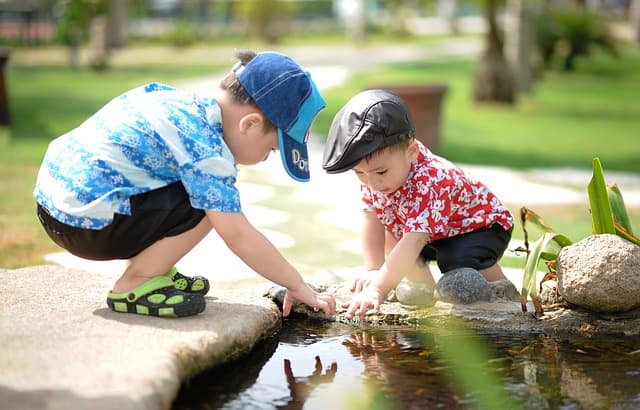
In this picture, what do you think will most probably happen next?
范文答案
Based on this scene, there are several highly likely developments that will occur in the next few minutes. First and foremost, the boy in the blue floral shirt and cap on the left is leaning forward significantly on his haunches. Because his center of gravity is quite high and he is reaching quite far out over the water, he will likely lose his balance in a moment. If his foot slips off the wet edge of the concrete or if he stretches just a bit further, he will probably tumble forward into the shallow pond. Although the water appears to be quite shallow, his blue shirt and shorts will get completely soaked, causing him to either burst into surprised laughter or start crying from the sudden cold shock.
Simultaneously, the younger boy on the right, wearing the red floral shirt and leather cap, is also focusing intently on the water's surface. He seems to be reaching down to touch something reflecting in the pool, possibly a small fish or a floating leaf. In a few seconds, he will likely touch the water, creating ripples that will startle whatever small creature is swimming near the surface. This action will prompt both boys to gasp in excitement, point at the water, and chatter animatedly to each other about what they have discovered.
Shortly after this, their parents or guardians, who are currently out of frame, will notice how close the toddlers have crawled to the edge. Recognizing the immediate risk of them falling in, an adult will hurriedly walk over to the pond, gently pull both boys away from the water, and instruct them to stand back. The parent will probably wipe their wet hands with a towel and guide them toward a safer play area in the park, perhaps to play on some nearby swings or run on the grassy lawn.
专家技巧与辅导
深入理解第四题(预测未来的场景)
在雅思考试不适用的 CELPIP 考试中,口语第四题(Task 4)要求考生根据画面中给出的视觉线索预测接下来的发展。与注重细节描述的第三题(Task 3)不同,第四题要求你进行合理的逻辑延伸。考官会评估你使用精准的将来时态和条件句来构建合理预测的能力。你的预测应该基于画面现状,而非毫无根据地凭空捏造。
构建合理的预测场景
你的预测必须紧扣画面细节。在这张图片中,关键细节包括:两名幼儿危险地蹲在池塘边缘、双手伸向水面,以及周围似乎缺乏大人看管。高分考生的回答会把这些身体姿态和周围环境与接下来的结果(如滑入水中或被家长拉回)直接联系起来。
最大化利用60秒准备与答题时间
由于答题时间只有短短的60秒,快速合理的规划至关重要。你需要迅速规划出两到三个预测方向,避免话语重复或在中途无话可说。
30秒快速构思策略
在准备时间内,将画面分为几个预测区域:
- 区域 1:左侧的男孩。 观察他的身体平衡。他过度向前倾,这意味着“滑倒”是最合理的预测。
- 区域 2:右侧的男孩。 观察他的手部动作。他正在触碰水面,这预示着他可能会与水中的小动物或波纹互动。
- 区域 3:整体环境。 思考画面中缺失的角色。家长在哪里?这可以引出关于家长介入的合理结尾。
控制表达语速
不要急于一口气说完全部预测。花点时间详细描述为什么你认为这件事会发生。你可以参考标准的高分范文,学习如何通过加入细节描述和过渡词来自然拉长答题时间,避免尴尬的停顿。
熟练运用预测性语言和将来时态
要在 CELPIP 考试中获得 9 分或以上的高分,你必须展示多样化的将来时和情态动词。避免反复使用单一的 'will'。相反,要交替使用不同的预测性词汇。
高频情态动词与句型
- 高概率: 'is likely to'(很可能)、'is bound to'(注定会)、'is expected to'(预计会)
- 中等概率: 'might'(也许)、'could'(可能)、'may possibly'(大概会)
- 推测性词汇: 'presumably'(据推测)、'most probably'(极有可能)、'in all likelihood'(十有八九)
弱表达 vs 优秀预测句型对比
- 弱表达: 'The boy will fall in the water.'(男孩会掉进水里。)
- 优秀表达: 'Given how far the boy is leaning forward, he is highly likely to lose his footing and tumble directly into the shallow pool.'(鉴于小男孩身体前倾的幅度,他极有可能失去平衡,直接摔进浅水池中。)
避免“清单式”陈述:动作 + 细节
许多考生在第四题中容易陷入“列清单”的误区,只是机械地列出一些零散的预测(“男孩会玩耍,另一个会哭,小狗会跑”)。相反,你应该把预测串联成一个因果相扣的故事线。
预测链构建法
通过将“当前的视觉线索 -> 直接结果 -> 后续连锁反应”串联起来,使你的叙述逻辑紧密:
- 视觉线索: 男孩正把手深深地伸进水里。
- 直接结果: 他的手指会触碰并搅动水面,产生阵阵涟漪。
- 连锁反应: 涟漪会惊扰附近的小鱼,两个孩子随之兴奋地惊呼起来。
这种一环扣一环的预测能向考官展现极其流畅的语言逻辑和连贯性。
预测过渡词汇与表达
过渡词就像是指路明灯,能引导考官顺着你的时间线和空间逻辑理解你的预测。使用表示时间和空间的过渡词可以让表达更加顺畅。
时间顺序过渡词
- 'In the immediate future...'(在接下来的时间里...)
- 'Directly after this occurs...'(在这之后紧接着...)
- 'Subsequently, we can expect...'(随后,我们可以预料...)
空间与假设过渡词
- 'Looking at the boy on the right, if he reaches any further...'(看右边那个男孩,如果他再往前够一点的话...)
- 'Assuming they both stay dry, the next logical step would be...'(假设他们俩都没弄湿,那么接下来合理的发展是...)
扩充视觉描述词汇
为了提高你的词汇分数,请尝试用高阶同义词替换普通词汇。
本场景核心高级词汇
- 蹲下 (Crouch/Squat): 'perched on their haunches'(蹲坐着)、'kneeling at the water's edge'(跪在水边)
- 池塘 (Pond/Pool): 'water feature'(水景/水池)、'shallow basin'(浅水盆地)
- 滑倒 (Slip/Fall): 'toppling over'(倒下)、'tumbling forward'(向前摔倒)、'taking an unexpected plunge'(意外落水)
- 兴奋 (Excited): 'beaming with delight'(脸上洋溢着喜悦)、'chattered animatedly'(兴奋地喋喋不休)
流利度、语速及应对生词的策略
保持表达的顺畅度在口语考试中至关重要。如果你卡壳了或者突然想不起某个单词,千万不要愣住。
间接释义法(Circumlocution)
如果你不知道“crocs(洞洞鞋)”或“haunches(臀部/大腿后侧)”怎么说,可以用简单的词汇进行描述性解释:
- 替代 'He is squatting':'He is bent down low with his knees tucked under him.'
- 替代 'Crocs shoes':'He is wearing bright green, casual rubber footwear.'
缓解停顿的技巧
使用自然口语填充词给自己争取思考时间,而不会降低流利度分:'Indeed...'(确实...)、'It is highly probable that...'(极有可能的是...)、'Looking closely, one might assume...'(仔细观察,我们可以假定...)。保持冷静、沉稳的语速。
第四题常见备考误区
误区 1:把“预测”说成了“描述”
有些考生花了太多时间套用第三题的描述模板,描述照片此时此刻的样子。请记住,你必须在开篇10秒内迅速切入将来时态进行预测。
- 错误做法: 'There are two boys. One wears blue, one wears red. They are looking at the water.'(这里有两个男孩,一个穿蓝色,一个穿红色。他们在看水。)
- 正确做法: 'The boy in the blue shirt will likely reach too far and fall forward into the water.'(穿蓝色衬衫的男孩很可能会因为伸手够得太远而向前栽进水里。)
误区 2:脱离现实的科幻式幻想
避免做出不符合常理或过于戏剧化的预测(例如:水里突然跳出一只鲨鱼把他们吃掉)。预测应当基于日常的、合乎情理的逻辑。
- 错误做法: 'An alien spaceship might land in the park to rescue them.'(外星飞船可能会降落在公园里来营救他们。)
- 正确做法: 'A parent or guardian will likely step in to guide them away from the wet rocks.'(家长或监护人很可能会走过来,引导他们离开潮湿的岩石区域。)