
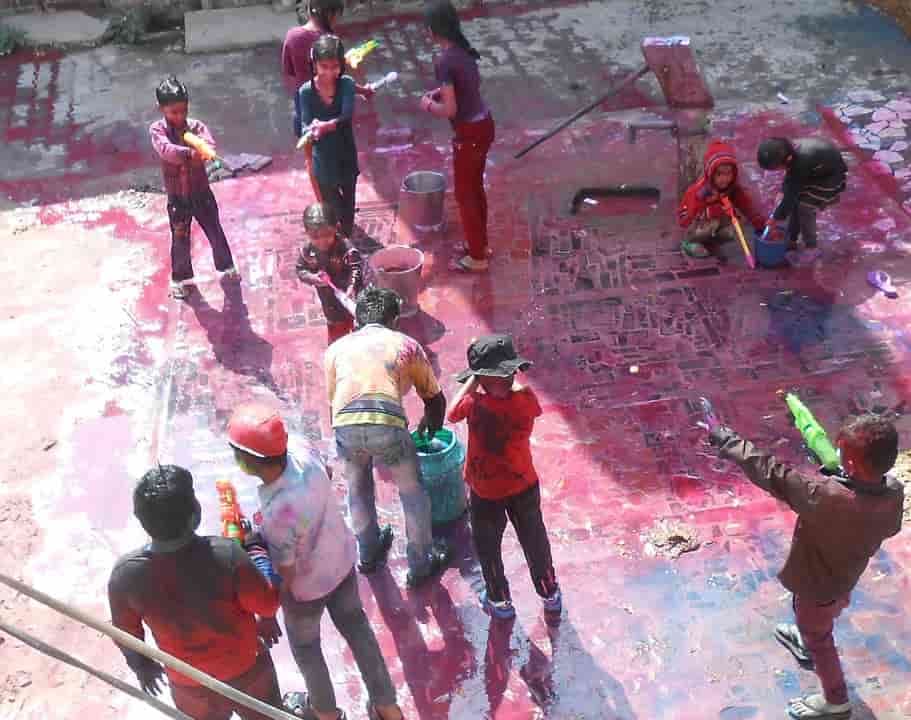
Water Gun Color Fight Celebration
The Question
In this picture, what do you think will most probably happen next?
Sample Answer
Based on the vibrant and energetic scene depicted in the image, a series of playful interactions are highly likely to unfold in the next few moments. First and foremost, in the bottom right-hand corner, the young boy wielding the large green-and-yellow water gun is poised to turn around and surprise-soak the two boys standing nearest to the camera. Since the boy in the red cap and his companion currently have their backs turned, they are completely oblivious to the impending splash and will likely react with startled laughter, immediately spinning around to retaliate with their own water launchers.
Simultaneously, in the center foreground, the boy wearing the yellow shirt and denim jeans is going to bend down and submerge his bucket into the blue container to refill his water reserves. Once his bucket is full, he will probably lift it quickly and drench the boy standing directly to his right in the red shirt, who is currently adjusting his black hat. The boy in the red shirt, anticipating this wet surprise, might try to duck or run away, but the wet and slippery conditions of the pink-stained concrete floor will force him to move carefully to avoid slipping.
Meanwhile, in the background, the intense battle near the water pump will escalate further. The girl in the dark blue shirt, who is holding her water gun ready, is going to be targeted by the young boy in the orange-and-red jacket sitting near the bucket. This boy will fill his small blue pail with water and toss it directly toward her feet, splashing her completely. Concurrently, the girls in the upper left corner will attempt to reload their water pistols at the central bucket station to prepare for another round of high-energy play.
Ultimately, as the water fight continues, all the participants will eventually run out of energy and water resources. Within the next half hour, the children will likely gather around the water pump to wash off the pink dye and clean their toys, laughing together over the exciting battle before heading indoors to dry off and enjoy a warm meal.
Expert Tips & Coaching
Understanding Task 4 (Predicting Outcomes)
In CELPIP Speaking Task 4, your primary objective is to look at an image and predict what is likely to happen next. Unlike Task 3, which asks you to describe what is currently happening, Task 4 is entirely forward-looking. Examiners are assessing your ability to use speculative language, future tenses, and logical reasoning based on visual evidence. A strong response goes beyond simple 'will' statements to paint a vivid picture of the immediate and near-future actions of the characters, maintaining a clear spatial and temporal structure.
Maximizing Your 60 Seconds
With only 60 seconds to speak, preparation and structure are paramount. During your 30 seconds of preparation, quickly identify three key areas of the image that show characters in the middle of an action. Ask yourself: 'What is the logical consequence of this action?' Use the first 10 seconds of your speaking time to set the stage, the next 40 seconds to make specific, detailed predictions about different groups of people, and the final 10 seconds to deliver a broad, satisfying conclusion. Pacing yourself prevents you from running out of time before finishing your narrative.
Mastering Speculative and Future Tense Grammar
To achieve a CELPIP Level 9+ score, you must demonstrate grammatical variety by using a range of future and speculative structures. Instead of repeatedly using 'He will do this' or 'She is going to do that', mix in advanced phrases such as:
- Is/Are poised to: 'The boy is poised to splash his friend.'
- Is/Are likely to / highly probable that: 'It is highly probable that the girl will run away.'
- Looks as though / appears to be on the verge of: 'He looks as though he is on the verge of slipping.'
- Future Continuous: 'They will be laughing and celebrating for hours.'
Weak Example: 'The boy will throw water. The other boy will run. It will be fun.'
Better Example: 'The boy in the yellow shirt is poised to drench his friend, who is likely to run away to avoid getting completely soaked.'
Avoiding the 'Static Description' Trap: Connecting Current States to Future Actions
Many test-takers lose points by describing the scene rather than predicting. To avoid this, use a simple two-step formula for each point you make: first, briefly state what a character is doing right now (the present cause), and second, predict what they will do next (the future effect).
Superficial Point: 'There is a boy with a green water gun.'
High-Scoring Connection: 'We can see a boy in the bottom right aiming a green water gun; next, he will likely pull the trigger and spray the unsuspecting boy in the red cap.'
Transitions for Chronological and Probabilistic Flow
Coherence and cohesion are critical scoring criteria. Use transitional phrases that indicate either a shift in time or a degree of probability to guide the examiner smoothly through your narrative:
- Chronological Transitions: 'Initially', 'In the immediate future', 'Simultaneously', 'Following this', 'Subsequently', 'Ultimately'.
- Probability Transitions: 'Undoubtedly', 'Almost certainly', 'There is a strong possibility that', 'Conceivably'.
Vocabulary Expansion for Dynamic Predictions
Elevate your score by replacing common words with descriptive, context-specific vocabulary. For outdoor active scenes, use terms like:
- Verbs of movement: Dodge, evade, scramble, retaliate, submerge, escalate, drench, saturate.
- Adjectives: Oblivious, impending, saturated, energetic, hazardous, festive.
- Nouns: Outpour, ammunition (referring to water), coordinates, vicinity.
Fluency, Pacing, and Handling Unknown Words
If you do not know the exact name of an object, do not freeze or use filler words like 'uh' or 'um'. Instead, use circumlocution—describe the object using words you do know. For example, if you forget the term 'water pump', you can refer to it as 'the metal water dispensing device in the background'. Keep your pace steady and natural; a controlled, clear delivery is far better than a rushed, error-filled monologue.
Common Task 4 Mistakes to Avoid
- Using the Simple Past Tense: Never describe the image as if it has already occurred. Always look forward.
- Failing to Link Predictions to Visual Evidence: Do not make wild, unrelated guesses. Every prediction should have a clear visual anchor in the photo.
- Focusing on Only One Detail: Ensure you predict actions for multiple people across the entire scene to show a comprehensive understanding.
Ready to Practice This Topic?
Use our AI-powered tool to record your answer and get instant CLB-scored feedback.
Practice with AI