
Vintage Mail Train Predictions
The Question
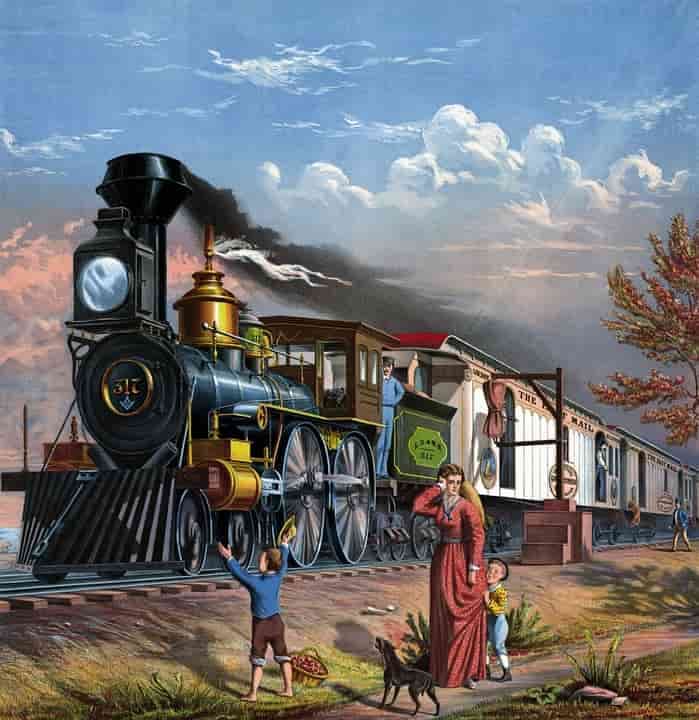
In this picture, what do you think will most probably happen next?
Sample Answer
Based on the visual clues in this historic illustration, several events are highly likely to unfold in the next few moments. First and foremost, the roaring steam locomotive, clearly labeled as number 317, will continue its forward journey along the metal tracks at a high speed. As it passes the wooden platform, the mechanical mail-transfer apparatus standing beside the tracks will go into action. The postal clerk standing near the open door of 'The Fast Mail' car will likely extend an iron arm or reach out to seamlessly grab the mailbag hanging from the trackside crane without the train needing to slow down or come to a halt.\n\nSimultaneously, the onlookers gathered near the tracks will react to the thunderous roar and escaping steam of the passing locomotive. The barefoot boy in the blue shirt will continue to wave his hat enthusiastically, cheering as the massive engine passes right in front of him. The dog, currently standing alertly beside the woman in the red dress, will probably start barking excitedly, startled by the sudden blast of the train's whistle and the thick black smoke billowing from the smokestack. The woman will likely tighten her grip on the small boy in the yellow shirt, keeping him safely away from the fast-moving train as she watches the massive steam engine speed away.\n\nWithin a couple of minutes, the entire train will have sped past this small rural crossing, leaving behind a lingering trail of dark smoke and dust. The family will then gather their belongings, including the basket of apples on the ground, and walk back to their nearby home, discussing the thrilling sight of the modern mail train.
Expert Tips & Coaching
Understanding Task 4 (Making Predictions)\nIn CELPIP Speaking Task 4, the examiners are not looking for a creative, wild fantasy story. Instead, they are evaluating your ability to make logical, evidence-based predictions based on the visual clues provided in the image. You must connect what is visible (the 'cause') to what will likely happen next (the 'effect'). A high-scoring response demonstrates strong command of future tenses, speculative language, and precise vocabulary.\n\n## Maximizing Your 60 Seconds\nWith only 60 seconds of speaking time, planning is everything. During your 30-second preparation phase, do not try to write down full sentences. Instead, identify three distinct sequences of action that are about to occur. Use the extended sample answer to study how to frame transitions and connect ideas quickly. Aim to structure your speech with a brief introduction, two or three solid prediction points, and a concluding prediction.\n\n## Mastering Predictive Grammars and Modals\nTo sound natural and achieve a high CLB level, you must avoid repeating 'will' in every sentence. Instead, incorporate a variety of future tenses and modals of probability:\n* Strong Probability: 'is/are bound to', 'is/are highly likely to', 'is about to'\n* Moderate Probability: 'will probably', 'is expected to', 'might'\n* Weak vs. Better Examples:\n * Weak: 'The train will pass and the boy will wave.'\n * Better: 'The steam engine is about to roar past the onlookers, who are highly likely to cover their ears due to the deafening noise.'\n\n## Avoiding the 'List' Trap: Hypothesis + Visual Clue\nDo not just list random predictions. Each prediction should be tethered to a specific visual clue in the image. This creates a cohesive narrative chain:\n* Step 1: Identify Clue -> The trackside mail crane with a hanging pouch.\n* Step 2: Formulate Prediction -> The mail clerk on the moving train will grab it.\n* Step 3: Combine with Speculation -> 'Given the presence of the mail-catching crane, the clerk on the carriage is likely preparing to snatch the mailbag as the train speeds past.'\n\n## Transitions for Speculating and Projecting Forward\nUse professional transition phrases to guide the listener through your speculative timeline:\n* 'In the immediate future...'\n* 'Following this initial action...'\n* 'As a direct consequence of this...'\n* 'Looking further ahead, it is highly probable that...'\n* 'Simultaneously, we can expect...'\n\n## Vocabulary Expansion for Dynamic Speculation\nEnhance your descriptive power by incorporating advanced adjectives and action verbs related to motion and reaction:\n* Verbs of Motion: 'to barrel down', 'to hurtle', 'to billow', 'to snatch', 'to scramble'\n* Descriptive Adjectives: 'deafening', 'impending', 'startled', 'imminent', 'gargantuan'\n* Example Sentence: 'As the gargantuan locomotive barrels down the tracks, thick plumes of soot will continue to billow into the sky, temporarily obscuring the horizon.'\n\n## Fluency, Pacing, and Handling Unknown Objects\nIf you see an object you do not know the exact English name for (such as the historical 'mail catcher hook'), do not panic or pause. Use circumlocution (describing the object using words you know):\n* Strategy: Describe its function. 'The wooden post with the hanging sack' or 'the metal device designed for catching items'.\nKeep your pace steady, and if you make a grammatical error, quickly correct yourself and keep going without long silences.\n\n## Common Task 4 Mistakes to Avoid\n* Mistake 1: Staying in the Present Tense. Candidates often describe what is happening now rather than predicting what happens next.\n* Mistake 2: Wild Speculation. Predicting that an alien spaceship will land near the train ruins the logical validity of your response. Keep predictions realistic to the historical setting.\n* Mistake 3: Getting Stuck. Focusing on only one character for the entire 60 seconds. Ensure you predict actions for the train, the people, and the animal.
Ready to Practice This Topic?
Use our AI-powered tool to record your answer and get instant CLB-scored feedback.
Practice with AI