
Two Little Boys Playing by a Park Pond
The Question
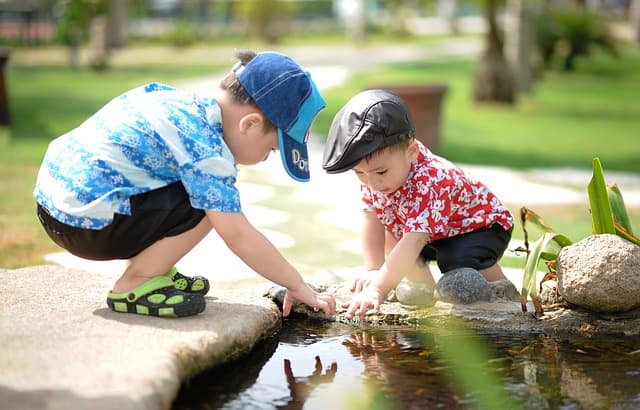
In this picture, what do you think will most probably happen next?
Sample Answer
Based on this scene, there are several highly likely developments that will occur in the next few minutes. First and foremost, the boy in the blue floral shirt and cap on the left is leaning forward significantly on his haunches. Because his center of gravity is quite high and he is reaching quite far out over the water, he will likely lose his balance in a moment. If his foot slips off the wet edge of the concrete or if he stretches just a bit further, he will probably tumble forward into the shallow pond. Although the water appears to be quite shallow, his blue shirt and shorts will get completely soaked, causing him to either burst into surprised laughter or start crying from the sudden cold shock.
Simultaneously, the younger boy on the right, wearing the red floral shirt and leather cap, is also focusing intently on the water's surface. He seems to be reaching down to touch something reflecting in the pool, possibly a small fish or a floating leaf. In a few seconds, he will likely touch the water, creating ripples that will startle whatever small creature is swimming near the surface. This action will prompt both boys to gasp in excitement, point at the water, and chatter animatedly to each other about what they have discovered.
Shortly after this, their parents or guardians, who are currently out of frame, will notice how close the toddlers have crawled to the edge. Recognizing the immediate risk of them falling in, an adult will hurriedly walk over to the pond, gently pull both boys away from the water, and instruct them to stand back. The parent will probably wipe their wet hands with a towel and guide them toward a safer play area in the park, perhaps to play on some nearby swings or run on the grassy lawn.
Expert Tips & Coaching
Understanding Task 4 (Making Predictions)
In CELPIP Speaking Task 4, your objective is to predict future actions based on visual evidence from an image. Unlike Task 3, which is purely descriptive, Task 4 requires you to project a narrative forward. Examiners look for your ability to construct logical, speculative scenarios using precise future tenses and conditional structures. You are not just guessing randomly; you are building a bridge between what is visible now and what will happen in the immediate or near future.
Formulating Logical Scenarios
Your predictions must stem directly from the details visible in the scene. In this image, the critical details are the children's precarious crouching postures, their proximity to the water's edge, and their lack of immediate adult supervision. High-scoring responses link these physical details directly to logical consequences, such as slipping into the water or being pulled back by a parent.
Maximizing Your 60 Seconds
With only 60 seconds of speaking time, planning is essential. You must quickly establish two or three main prediction tracks to avoid repeating yourself or running out of ideas.
The 30-Second Prep Strategy
During your preparation time, divide the scene into predictable zones.
- Zone 1: The Left Boy. Observe his physical balance. Leaning too far forward makes slipping the most likely prediction.
- Zone 2: The Right Boy. Observe his hand position. Touching the water suggests interaction with marine life or ripples.
- Zone 3: The Broader Environment. Think about who is missing. Where are the parents? This yields a natural conclusion involving parental intervention.
Pacing Your Speech
Do not rush through your first prediction. Take your time to detail why you think it will happen. Use the extended model answer to study how descriptive phrases and transitions expand your speaking time naturally, preventing awkward silences.
Mastering Predictive Language and Future Tenses
To score at a CELPIP Level 9 or higher, you must demonstrate a wide range of future and modal verbs. Avoid using 'will' repeatedly. Instead, vary your predictive vocabulary.
High-Yield Modal Verbs
- Likelihood: 'is likely to', 'is bound to', 'is expected to'
- Possibility: 'might', 'could', 'may possibly'
- Assumption: 'presumably', 'most probably', 'in all likelihood'
Weak vs. Better Predictive Structures
- Weak: 'The boy will fall in the water.'
- Better: 'Given how far the boy is leaning forward, he is highly likely to lose his footing and tumble directly into the shallow pool.'
- Weak: 'A parent will come.'
- Better: 'In all probability, an adult supervisor will quickly intervene to pull the children back to safety.'
Avoiding the 'List' Trap: Action + Detail
In Task 4, the 'list' trap occurs when test-takers simply list random future events ('The boy will play. The other boy will cry. A dog will run.'). Instead, construct cohesive cause-and-effect sequences.
Constructing a Predictive Chain
To build a cohesive response, connect a visible action to an immediate consequence, and then to a long-term resolution.
- State the Visible Cue: The boy is reaching deep into the water.
- Predict the Direct Consequence: His fingers will make contact with the water, creating ripples.
- Predict the Reaction: This will startle a nearby fish, causing both toddlers to squeal with joy.
This continuous narrative flow demonstrates superior linguistic coherence to the examiner.
Transitions for Moving Through Predictions
Transition words act as signposts, guiding the examiner through your speculative timeline. Use chronological and spatial transitions to connect your ideas smoothly.
Chronological Transition Phrases
- 'In the immediate future...'
- 'Directly after this occurs...'
- 'Subsequently, we can expect...'
- 'Over the next few minutes...'
Spatial and Conditional Transitions
- 'Looking at the boy on the right, if he reaches any further...'
- 'Parallel to this, on the left side of the frame...'
- 'Assuming they both stay dry, the next logical step would be...'
Vocabulary Expansion for Visual Imagery
To raise your vocabulary score, replace basic terms with descriptive synonyms.
Key Synonyms for This Scene
- Crouching / Squatting: 'Bent double', 'perched on their haunches', 'kneeling at the water's edge'
- Pond / Pool: 'Water feature', 'shallow basin', 'aquatic environment'
- Slipping / Falling: 'Losing balance', 'toppling over', 'tumbling forward', 'taking an unexpected plunge'
- Surprised / Excited: 'Astonished', 'thrilled', 'chattered animatedly', 'beaming with delight'
Sample Sentences using Advanced Vocabulary
- 'Perched on his haunches, the toddler is in a highly unstable position.'
- 'The sudden splash will likely cause an unexpected plunge, turning their peaceful afternoon into a damp ordeal.'
Fluency, Pacing, and Handling Unknown Words
Maintaining a smooth delivery is critical. If you stumble or do not know a specific word, do not freeze.
Circumlocution Techniques
If you do not know the word for 'haunches' or 'crouching', use descriptive alternatives:
- Instead of: 'He is squatting.'
- Use: 'He is bent down low with his knees tucked under him.'
- Instead of: 'Moccasins / Crocs.'
- Use: 'He is wearing bright green, casual rubber footwear.'
Managing Hesitations
Use natural fillers that buy you time to think without lowering your fluency score: 'Indeed...', 'It is highly probable that...', 'Looking closely, one might assume...'. Keep your voice even and calm.
Common Task 4 Mistakes to Avoid
Mistake 1: Describing Instead of Predicting
Many candidates spend too much time repeating Task 3 strategies, describing the image as it is now. You must shift to the future tense within the first 10 seconds.
- Incorrect: 'There are two boys. One wears blue, one wears red. They are looking at the water.'
- Correct: 'The boy in the blue shirt will likely reach too far and fall forward into the water.'
Mistake 2: Overly Wild Speculations
Avoid making sci-fi or highly unrealistic predictions (e.g., 'A shark will jump out of the pond and eat them'). Stick to everyday, realistic outcomes.
- Incorrect: 'An alien spaceship might land in the park to rescue them.'
- Correct: 'A parent or guardian will likely step in to guide them away from the wet rocks.'
Ready to Practice This Topic?
Use our AI-powered tool to record your answer and get instant CLB-scored feedback.
Practice with AI