
Predicting a Friendly Patrol Interaction in a Rural Village
The Question
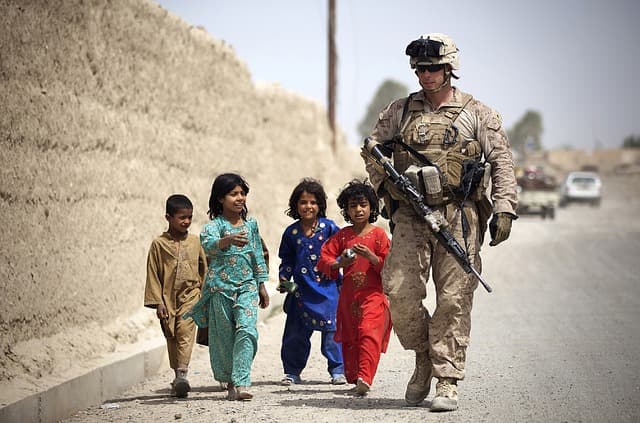
In this picture, what do you think will most probably happen next?
Sample Answer
As this peaceful interaction continues along the dusty village road, several likely developments will unfold in the next few minutes. Initially, the soldier, who is maintaining a friendly yet vigilant posture, will likely reach into one of his tactical vest pouches to offer the children some small gifts, such as candy, bottled water, or writing materials. The children, who already appear incredibly curious and happy to walk alongside him, will eagerly accept these tokens with smiles and gestures of gratitude.
Following this brief exchange, the young girl in the red dress might point toward her home or her family standing further down the road, prompting the soldier to wave warmly to the local villagers to reinforce a sense of community trust and safety. Concurrently, the military patrol team, potentially including the distant vehicle visible in the dusty background, will gradually catch up to the soldier's position. This vehicle will slow down to ensure the safety of the pedestrian children before continuing its slow reconnaissance down the unpaved path.
To maintain his unit's operational timeline, the soldier will gently bid farewell to his young companions, gesturing for them to step safely away from the roadway and return toward the shelter of the high mud-brick walls on the left. Ultimately, the four children will stand together near the roadside, waving enthusiastically as the patrol moves further into the horizon. The soldier will adjust his rifle sling, re-focus his attention on the surrounding environment, and report his status over his communication headset, returning the quiet, sun-drenched rural pathway to its everyday state.
Expert Tips & Coaching
Understanding Task 4 (Making Predictions)
In CELPIP Speaking Task 4, your primary objective is to look at the provided scene and forecast what is most likely to happen next. Unlike Task 3, which requires a literal description of what is currently visible, Task 4 tests your ability to speculate logically, use future tenses, and formulate plausible hypotheses. The key here is 'plausibility'—your predictions must directly stem from the visual evidence. For instance, in this image, predicting that the soldier will give the children a treat or that they will wave goodbye is highly logical; predicting an alien invasion or an immediate outbreak of a major battle would be considered off-topic and structurally weak because there is no visual indicator to support such dramatic turns.
To achieve a CLB 9 or higher, examiners look for:
- Logical progression: A coherent sequence of events (immediate future, mid-term future, and conclusion).
- Advanced grammatical structures: Regular and precise use of future tenses, conditional structures, and modal verbs of speculation.
- Precision vocabulary: Transition words that signal sequence and time, along with detailed descriptive words for hypothesized actions.
Maximizing Your 60 Seconds
With only 60 seconds to speak, pacing is everything. Do not try to describe the current scene from scratch—you should assume the examiner already knows what is in the picture. Instead, dive straight into the predictions.
To maximize your score, structure your time as follows:
- The First 15 Seconds (Immediate Actions): Describe what the characters will do in the next few seconds (e.g., stopping to talk, offering small items).
- The Middle 30 Seconds (Subsequent Events): Describe how the wider environment changes (e.g., the distant vehicle approaching, the children's families appearing, or the group split-up).
- The Final 15 Seconds (Resolution/Atmospheric End): Provide a concluding prediction about how the entire scene will look once the main action is complete (e.g., the dust settling, the soldier continuing his route alone).
Use the extended sample answer as a master class in planning: it builds a narrative from the immediate hand-held interaction to the movement of the vehicle, and finally to the long-term departure of the patrol.
Mastering Predictive Auxiliaries and Tenses
Using only the word 'will' repeatedly makes your response sound repetitive and simplistic. High-scoring candidates use a diverse range of predictive auxiliaries, modals, and conditional structures to express different degrees of certainty.
Speculative Modals and Probability Phrases
- Highly Certain: is/are bound to, is/are highly likely to, will undoubtedly
- Moderately Certain: will probably, is/are expected to, should reasonably
- Possibility/Speculative: might, could potentially, may perhaps, there is a distinct possibility that
Structural Comparison:
- Weak: 'The soldier will walk. The kids will go home.'
- Better: 'The soldier is highly likely to pause his march briefly, and he will probably reach into his tactical vest. Meanwhile, the children could potentially guide him towards their nearby homes.'
Avoiding the 'List' Trap: Action + Logical Extension
In Task 4, many test-takers fall into the trap of simply listing disconnected future events: 'The girl will run. The boy will jump. The car will drive.' This sounds robotic.
Instead, use the Action + Logical Extension formula. For every prediction you make, explain why it will happen based on what you see, or detail the consequence of that action.
- Formula: [Visual Clue] + [Predictive Verb] + [Logical Consequence/Purpose]
- Example: 'Because the children are smiling and walking closely beside the soldier (Visual Clue), they will likely accompany him for a few more yards (Predictive Verb) in order to prolong their pleasant interaction before they have to turn back (Logical Consequence).'
This formula naturally forces you to use complex subordinating clauses (e.g., because, so that, in order to, which will result in), boosting your grammar score significantly.
Transitions for Sequencing Future Events
To guide your listener smoothly through time, you must use precise sequential transitions. Here are highly effective transitional phrases categorized by chronological phases:
1. The Immediate Future (First 5–10 seconds)
- In the immediate future...
- In the moments directly following this...
- To begin with, we can expect that...
2. The Mid-Term Future (Next 20–30 seconds)
- Shortly thereafter...
- Concurrently, in the background...
- As this interaction unfolds, the next logical step will be...
- Following this brief exchange...
3. The Ultimate Future/Resolution (Final 10–15 seconds)
- Ultimately, as the patrol moves out of sight...
- In the final analysis, the scene will likely resolve with...
- Eventually, we can expect the area to return to...
Vocabulary Expansion for Speculation and Probability
To showcase high-level vocabulary, incorporate words that relate directly to prediction, speculation, and the specific setting of the image:
- Reconnaissance (Noun): Military observation of a region.
Example: 'The distant vehicle will likely continue its reconnaissance mission down the dusty road.' - Vigilant (Adjective): Keeping careful watch for possible danger.
Example: 'While interacting with the children, the soldier will remain highly vigilant of his surroundings.' - Bidding Farewell (Verb Phrase): Saying goodbye.
Example: 'After exchanging friendly smiles, the soldier will gently bid farewell to his young companions.' - Plausible (Adjective): Seemingly reasonable or probable.
Example: 'It is highly plausible that the children will return safely to their homes once the patrol passes.' - Diminish (Verb): Make or become less.
Example: 'The sounds of the vehicle will gradually diminish as it drives further into the distance.'
Fluency, Pacing, and Handling Unknown Words
One of the biggest challenges in Task 4 is maintaining fluency while trying to think of creative future events. If you hesitate or pause excessively while brainstorming what 'might' happen, your fluency score will drop.
Tips for Continuous Flow:
- Embrace Circumlocution: If you do not know the exact military terms (e.g., 'tactical vest', 'muzzle-down rifle position', 'fatigues'), use descriptive approximations. Call them 'protective military clothing', 'the soldier's gear', or 'his equipment pouches'.
- Buy Time with Speculative Fillers: Instead of saying 'uh' or 'um' when thinking, use filler phrases that fit the speculative nature of the task:
- 'Looking at the spatial arrangement, one might reasonably assume that...'
- 'Another highly anticipated outcome could be...'
- 'It is also worth considering the possibility that...'
- Keep Your Pace Steady: Do not rush through your points. Speak at a calm, conversational speed. It is much better to explain three predictions thoroughly with logical extensions than to rattle off ten rapid, simplistic guesses.
Common Task 4 Mistakes to Avoid
Mistake 1: Describing the Present Instead of Predicting
- Weak: 'The soldier is wearing a helmet and holding a gun. The children are walking next to him on a dirt road.' (This is a Task 3 response, not Task 4. You will lose significant marks for task fulfillment.)
- Improved: 'The soldier, who is currently carrying a heavy pack, will likely adjust his gear as he continues walking, while the children will probably run ahead to show him the way.'
Mistake 2: Lack of Grounding / Unrealistic Speculation
- Weak: 'Suddenly, a helicopter will land and rescue the kids from a sandstorm.' (There are no indicators of a helicopter or an impending sandstorm, making this prediction groundless.)
- Improved: 'Given the clear sky and dry conditions, the heat is expected to intensify, prompting the children to seek shade near the mud-brick wall as the soldier marches on.'
Mistake 3: Over-relying on 'Will'
- Weak: 'The soldier will talk, the children will laugh, the car will come, and they will go.'
- Improved: 'While the soldier is anticipated to communicate with his team, the children are bound to share a quick laugh before eventually dispersing back to their homes.'
Ready to Practice This Topic?
Use our AI-powered tool to record your answer and get instant CLB-scored feedback.
Practice with AI