
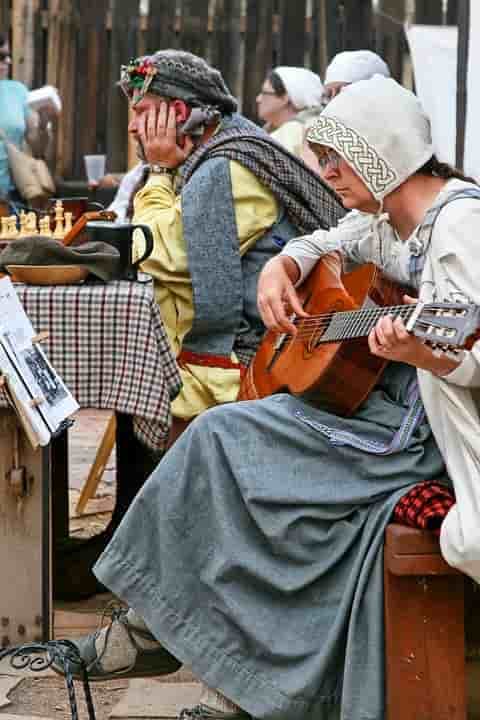
Medieval Reenactors Playing Music and Chess at a Historical Festival
The Question
In this picture, what do you think will most probably happen next?
Sample Answer
Based on the visual evidence in this lively historical scene, we can make several logical predictions about what will happen next. In the immediate future, the woman sitting in the foreground on the wooden bench will finish strumming the current melody on her acoustic guitar. As soon as she plays the final chord, the two onlookers dressed in medieval headwear standing near the wooden fence in the background will break into warm applause, expressing their appreciation for her musical performance.
Simultaneously, the man wearing the braided cap and plaid shoulder drape, who is currently leaning his head heavily on his hand in deep contemplation, will finally make a decision regarding his next chess move. He is likely to reach his hand out, pick up one of the wooden chess pieces from the checkered table, and advance it across the board to challenge his unseen opponent. After executing his move, he will likely release a sigh of relief, sit back, and take a long sip from the dark ceramic mug resting next to the chessboard.
Looking slightly further ahead, once the chess match concludes and the musical performance wraps up, the entire group will probably gather around the table to socialize. The woman might set her guitar aside on the bench and join the conversation, perhaps sharing some stories about the historical instruments.
Ultimately, as the afternoon sun begins to set and the Renaissance festival draws to a close, these reenactors will pack up their belongings. They will carefully pack the chess pieces into their box, wrap the guitar in its protective case, fold the checkered tablecloth, and depart the festival grounds, looking forward to resting after a highly engaging and successful historical reenactment event.
Expert Tips & Coaching
Understanding Task 4 (Making Predictions)
CELPIP Speaking Task 4 evaluates your ability to look at an image and project a logical sequence of future events. Unlike Task 3, which asks you to describe what is currently happening, Task 4 demands that you use the present scene as a springboard for speculation. The examiners are not looking for wild, unrealistic fantasies; they want to see logical, evidence-based predictions that are directly tied to the visual clues in the picture.
To score at a CELPIP Level 9 or higher, you must demonstrate a mastery of future tenses, conditional structures, and speculative language. Your response should show that you can organize your thoughts chronologically, transitioning smoothly from immediate next steps to eventual outcomes. This task tests your cognitive flexibility and linguistic control under time pressure, requiring you to speak continuously for 60 seconds with minimal hesitation.
Maximizing Your 60 Seconds
With only 30 seconds of preparation time and 60 seconds of speaking time, efficiency is key. Use your preparation time to identify two or three primary subjects in the image who are engaged in an action that has an obvious continuation. In this image, the woman playing the guitar and the man contemplating his chess move are perfect focal points.
Do not try to write down full sentences during your preparation. Instead, quickly note down a simple chronological timeline in your head:
- Immediate (0-5 seconds next): The guitar song ends; the chess move is made.
- Intermediate (next few minutes): Applause from onlookers; a drink from the mug; resetting the chessboard.
- Long-term (end of the day): Packing up and leaving.
When speaking, pace yourself. Do not rush through your predictions. The extended sample answer provided above contains a wealth of high-yield vocabulary and complex structures. Use it to practice your timing, aiming to deliver about 130 to 150 words during the actual 60-second response while maintaining clear pronunciation and natural intonation.
Mastering Predictive Tenses and Speculative Language
To sound like a natural, high-level English speaker, you must avoid repeating 'will' over and over again. Instead, vary your speculative grammar to show different degrees of certainty. Here are some key structures to incorporate:
Formulating Degrees of Probability
- High Certainty: 'is bound to', 'is sure to', 'will definitely'
- Example: 'The man is bound to make his move soon because he has been contemplating the board for a long time.'
- Medium Probability: 'is likely to', 'will probably', 'is expected to'
- Example: 'The onlookers are likely to clap once the song ends.'
- Low Probability/Speculation: 'might', 'could possibly', 'may be planning to'
- Example: 'The woman might decide to tune her guitar before starting another song.'
Utilizing Future Continuous and Future Perfect
Using advanced future tenses can instantly elevate your score:
- Future Continuous: 'This time tomorrow, they will be performing at a different historical site.'
- Future Perfect: 'By the time the sun sets, they will have completed several rounds of chess.'
Avoiding the 'Random Guessing' Trap: Evidentiary Predictions
A common mistake candidates make is predicting events that have absolutely no connection to the image. For instance, saying 'A helicopter will land next to them' is highly illogical and will lower your score because it ignores the context of the Renaissance festival.
Every prediction you make must have an 'anchor' in the visual scene. Use this simple formula to ensure your predictions are evidence-based:
- Weak Example: 'The man is going to go to a restaurant.' (No evidence supports this specific location).
- Better Example: 'Given that there is a large ceramic mug on the table, the man is likely to take a sip of his beverage once he finishes his chess turn.' (Directly tied to an visible object).
Transitions for Structuring Future Timelines
To ensure your response flows logically, you need clear transitional phrases that guide the listener through your projected timeline. Avoid abrupt jumps. Instead, use these temporal signposts:
- For Immediate Actions:
- 'In the blink of an eye...'
- 'Almost immediately...'
- 'In the very next moment...'
- For Intermediate Developments:
- 'Following this initial action...'
- 'Shortly thereafter...'
- 'Looking slightly further ahead...'
- For Long-term Outcomes:
- 'Ultimately, as the day winds down...'
- 'In the final analysis...'
- 'Concurrently, by the end of the afternoon...'
Vocabulary Expansion for Speculation and Probability
To achieve strong CLB 9-level fluency, replace basic verbs and nouns with highly descriptive vocabulary. Here is a list of advanced terms suited for this scene:
- Reenactor (noun): A person who participates in a historical reenactment.
- Sentence: 'The historical reenactors will likely gather to take a group photograph.'
- Contemplate (verb): To look thoughtfully for a long time at something.
- Sentence: 'After contemplating his options, the player will advance his knight.'
- Elicit (verb): To draw out or evoke a reaction.
- Sentence: 'Her beautiful performance will undoubtedly elicit a warm round of applause.'
- Garb (noun): Clothing, especially of a distinctive or special kind.
- Sentence: 'They will eventually change out of their medieval garb and put on modern clothing.'
- Unbeknownst (adverb): Without the knowledge of someone.
- Sentence: 'Unbeknownst to the chess player, his opponent is preparing a clever countermove.'
Fluency, Pacing, and Handling Unpredicted Elements
Maintaining a steady flow of speech is crucial. If you pause excessively while trying to think of the perfect word, your fluency score will drop.
Circumlocution Strategies
If you do not know the word for 'bonnet' or 'tunic', do not freeze! Use circumlocution (describing the object using words you do know):
- Instead of 'bonnet', say: 'The white head covering worn by the woman playing music.'
- Instead of 'chessboard', say: 'The checkered surface where they are playing the strategic game.'
Natural Fillers
If you need a moment to think, use professional-sounding fillers rather than 'um' or 'uh':
- 'It is highly probable that...'
- 'Looking closely at the details, we can assume that...'
- 'Another interesting development that might occur is...'
Common Task 4 Mistakes to Avoid
Avoid these frequent pitfalls to keep your score in the highest brackets:
- Using the Simple Present or Past Tense: Many test-takers accidentally describe the scene rather than predicting. Always check that your verbs point to the future ('will play', 'is going to move').
- Weak: 'The woman plays the guitar and the man sits.'
- Improved: 'In a few moments, the woman will finish playing her guitar, and the man will proceed to move his chess piece.'
- Focusing on Only One Person: Do not spend all 60 seconds predicting what the guitar player will do. Broaden your perspective to include the chess player and the background spectators to show a comprehensive grasp of the scene.
- Running Out of Things to Say: If you speak too quickly, you might finish all your predictions in 40 seconds. If this happens, transition to a broader, long-term prediction about the historical festival or the weather changes to fill the remaining time constructively.
Ready to Practice This Topic?
Use our AI-powered tool to record your answer and get instant CLB-scored feedback.
Practice with AI