
Historical War Council Planning next Moves
The Question
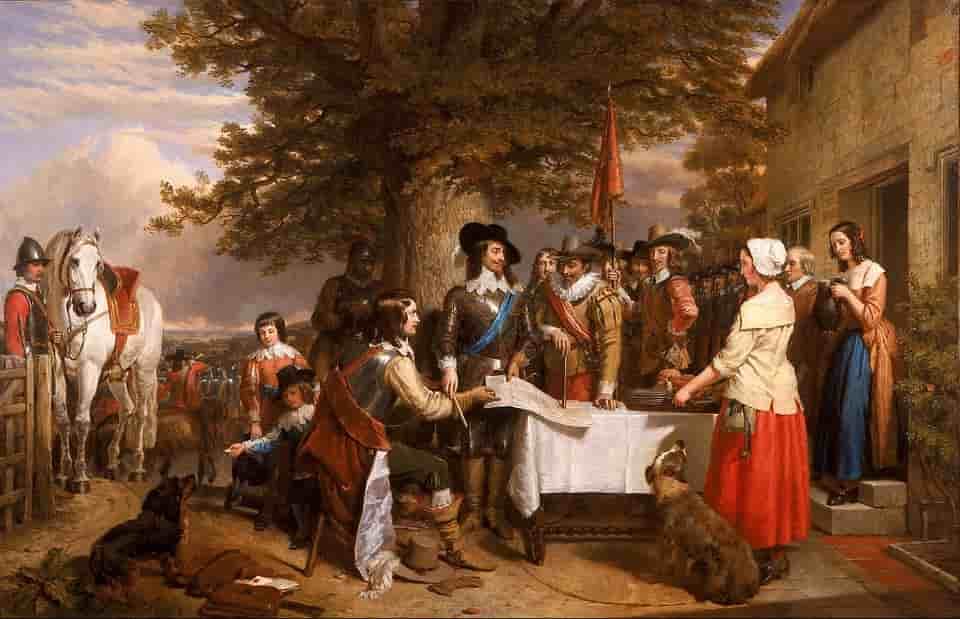
In this picture, what do you think will most probably happen next?
Sample Answer
Based on the visual evidence in this historical scene, several key developments are likely to unfold in both the short and long term.
First and foremost, the council of war gathered around the rustic table in the center will reach a final decision. The seated officer who is actively pointing at the map is poised to finish his tactical briefing within the next few moments. Following this, the commander standing in the center—distinguished by his blue sash and elegant breastplate—will likely sign the document or issue final marching orders. Once these plans are finalized, the other military personnel gathered under the large oak tree will begin to disperse to prepare their respective regiments.
Simultaneously, we can expect movement from the secondary characters surrounding the main council. On the far left, the soldier holding the reins of the white stallion will bring the horse forward so that the commander can mount it. The small dog resting in the left foreground will probably stand up and follow its master. Over on the right-hand side, the woman wearing the white cap and red skirt will finish serving drinks to the officers, collect her pitcher, and safely retreat into the stone house alongside the other civilian onlookers to stay out of harm's way.
Ultimately, within an hour or two, the entire military unit carrying their red banners and muskets will mobilize. They will depart from this courtyard and march toward the battlefield visible in the distant background. The clear, bright sky suggests they will travel under favorable weather conditions, though the serious expressions of the men indicate that a high-stakes, historical conflict is about to commence just beyond the horizon.
Expert Tips & Coaching
Understanding Task 4 (Making Predictions)
CELPIP Speaking Task 4 tests your ability to look at a static image and predict what is likely to happen next. Unlike Task 3, where you simply describe what you see, Task 4 requires you to use your imagination coupled with logical deduction. The key to scoring CLB 9 or higher is to provide predictions that are directly supported by visual evidence in the picture. The examiners evaluate your response based on the variety of your grammatical structures, the natural flow of your transitions, and the plausibility of your predictions.
Maximizing Your 60 Seconds
With only 60 seconds to speak, preparation and structure are everything. During your 30-second preparation time, do not try to write down full sentences. Instead, quickly identify three main areas of the image to predict: the immediate central action, the secondary characters' movements, and the overall outcome of the scene. When speaking, pace yourself so that you spend roughly 15 seconds on the immediate actions, 30 seconds on the midground and background characters, and the final 15 seconds on a broader, long-term prediction. This ensures you do not run out of time before concluding your thoughts.
Mastering Predictive Vocabulary and Modals
To sound natural and sophisticated, you must avoid repeating 'will' or 'is going to' constantly. Instead, weave in a rich variety of speculative modals and predictive phrases:
- Highly Likely: 'is bound to', 'is poised to', 'is almost certain to', 'will undoubtedly'.
- Probable: 'is likely to', 'will probably', 'is expected to'.
- Possible/Speculative: 'might possibly', 'could potentially', 'it is plausible that'.
Weak Example: The man will sign the paper and then the horse will move.
Better Example: The commander is poised to sign the treaty, after which the soldier on the left is expected to bring the white horse forward.
Avoiding the 'List' Trap: Action + Logical Consequence
Many candidates fail to get a high score because they merely list future actions: 'This person will do X, then this person will do Y, and then that person will do Z.' This sounds repetitive and robotic. To break this habit, use the Action + Logical Consequence formula. Every time you make a prediction, explain why it will happen based on what is currently happening.
Weak: The woman on the right will go inside the house.
Improved: Given that the military officers are preparing for battle, the woman on the right is likely to retreat into the safety of the stone house to avoid the impending commotion.
Transitions for Structuring Future Scenarios
To guide the examiner through your predictions, use smooth spatial and sequential transitions:
- 'Starting with the focal point of the scene...'
- 'In the immediate future, we can expect to see...'
- 'Simultaneously, on the periphery of the image...'
- 'Looking at the background, it is highly probable that...'
- 'In the longer term, the ultimate outcome will likely be...'
Vocabulary Expansion for Speculative Scenarios
Here are some high-yield terms and collocations tailored for historical, outdoor, or group-planning scenes:
- To mobilize: To prepare and organize troops for active service.
- To disperse: To go in different directions; scatter.
- To retreat to safety: To move back to a secure location.
- Imminent: About to happen.
- In the pipeline: In progress or about to happen soon.
Example Sentence: As soon as the war council disperses, the soldiers are bound to mobilize immediately for their imminent march.
Fluency, Pacing, and Handling Uncertain Details
In historical paintings or complex scenes, you might not know the exact vocabulary for certain items (e.g., 'breastplate', 'reins', 'muskets'). If you get stuck, do not pause or stutter. Use circumlocution—describe the object using simpler words you know. For instance, if you do not know 'breastplate', you can say 'the metal armor worn on the torso'. If you do not know 'reins', say 'the leather straps used to hold the horse'. Keep your pacing steady and maintain your flow; examiners reward continuous, smooth speech over occasional complex vocabulary that causes hesitations.
Common Task 4 Mistakes to Avoid
- Mistake 1: Describing instead of predicting. Do not spend time describing what the characters are currently wearing or doing unless it directly supports a prediction. Transition immediately into the future.
- Mistake 2: Making unrealistic predictions. Do not predict that a spaceship will land or something completely unrelated to the historical context of the painting will occur. Keep your speculations grounded in the visual theme.
- Mistake 3: Getting stuck on one detail. Do not spend all 60 seconds predicting what the dog or the horse will do. Provide a balanced, birds-eye view of the entire scene's future.
Ready to Practice This Topic?
Use our AI-powered tool to record your answer and get instant CLB-scored feedback.
Practice with AI