
Four Friends Walking Near an Abandoned Gas Station
The Question
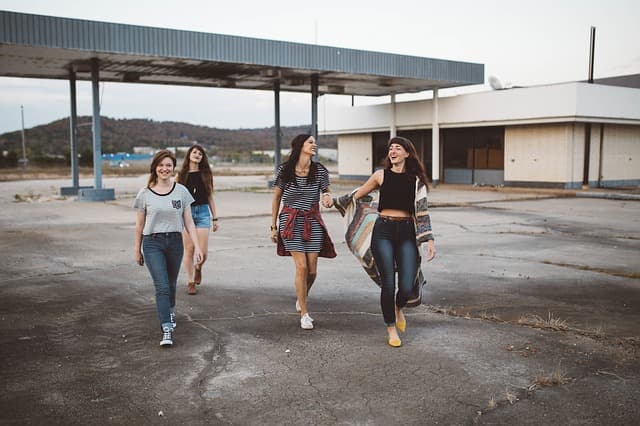
In this picture, what do you think will most probably happen next?
Sample Answer
First and foremost, looking at the joyful expressions of the four young women, it is highly probable that they will continue walking across this vacant, cracked concrete lot towards the foreground of the image. The two women in the center and on the right, who are currently holding hands, will likely lead the way while sharing a laugh, perhaps stopping momentarily to pose for a candid photograph. Given their trendy, casual outfits and cheerful demeanor, they might be on a road trip, suggesting that they will soon head toward a parked vehicle just out of frame to retrieve their phones or a camera to capture the rustic, vintage aesthetic of this abandoned service station.
Furthermore, as we observe the old, white building and the massive overhead canopy, some of the friends might decide to explore the structure. The girl on the far left, who is walking with an open and relaxed stride, might suggest walking closer to the glass windows of the building to peek inside out of curiosity. However, because the area looks completely deserted and slightly overgrown with patches of dry grass, they will probably choose not to venture deep inside for safety reasons. Instead, they are more likely to stay in the open lot, enjoying the spacious outdoor area.
Lastly, considering the soft, diffused light in the sky, which indicates it is either late afternoon or early evening, the group will likely wrap up their outdoor stroll soon. As the temperature begins to drop, the woman on the right might wrap her patterned cardigan more tightly around herself, and the group will make their way back to their car. They will likely drive to a nearby town to grab dinner at a local diner, reflecting on their memorable afternoon excursion.
Expert Tips & Coaching
Understanding Task 4 (Making Predictions)
CELPIP Speaking Task 4 tests your ability to make logical, imaginative predictions based on a single image. Unlike Task 3, which asks you to describe what is currently happening, Task 4 requires you to project into the future. Examiners look for a systematic approach, grammatical accuracy—especially regarding future and modal tenses—and the logical connection between visual clues in the image and your predictions.
To achieve a CLB 9+ level, you must avoid simplistic guesses. Your predictions should be structured, detailed, and directly tied to what you can see. For instance, rather than simply stating, 'They will leave,' you should explain why they will leave, using visual indicators like the dimming sky or their clothing as evidence.
Maximizing Your 30 Seconds
Your preparation time is incredibly short, so you must use it strategically to outline a coherent narrative:
- First 10 Seconds: Quickly identify the core subjects, their emotional states, and the setting. Here, we have four happy friends in front of a defunct gas station at what seems to be late afternoon.
- Next 10 Seconds: Map out two or three realistic scenarios. One immediate action (continuing their walk/taking pictures), one mid-term action (exploring the abandoned building), and one long-term wrap-up (leaving before dark).
- Final 10 Seconds: Formulate your opening statement and recall high-yielding transition words (e.g., 'In all likelihood', 'Subsequently', 'It is highly probable that').
By establishing a mental outline, you avoid long pauses and keep your delivery smooth and confident.
Mastering Predictive Language and Future Tenses
To secure a high score, you must demonstrate grammatical variety. Relying solely on 'will' or 'is going to' will make your speech repetitive. Instead, integrate a rich array of modal verbs and conditional phrases:
- High-Probability Events: Use phrases like 'is highly likely to', 'is expected to', or 'there is a strong chance that'.
- Example: 'It is highly likely that they will continue walking forward while laughing.'
- Speculative or Low-Probability Events: Use 'might', 'could potentially', or 'it is conceivable that'.
- Example: 'They might explore the abandoned building, though they could potentially decide it is unsafe.'
- Sequential Future Tenses: Use future continuous or future perfect to show advanced language control.
- Example: 'By the time they reach their car, the sun will have fully set.'
Avoiding the 'Unrealistic Guess' Trap: Logic-Based Speculation
One of the most common mistakes candidates make is making wild, contextually inappropriate guesses. For instance, predicting that 'an alien spaceship will arrive and abduct them' is creative but illogical and does not showcase professional English proficiency.
Instead, anchor every prediction to a visible clue:
- Observation: The sky is a pale, dusky white, and the ground has patches of dried grass.
- Logic-Based Prediction: 'Because the lighting suggests twilight is approaching and the temperature is likely dropping, the group will probably not stay outdoors much longer.'
- Observation: Two girls are holding hands and smiling broadly.
- Logic-Based Prediction: 'Given their strong bond and cheerful mood, they are likely to take a group photo together to commemorate their road trip.'
Transitions for Speculating and Sequencing Events
Smooth transitions are critical for coherence and flow. Use these phrases to sequence your predictions logically:
- To Introduce the Immediate Future: 'In the immediate future...', 'First and foremost, it appears that...'
- To Shift Focus or Introduce a Secondary Prediction: 'Following this...', 'Furthermore, looking at the background, we can speculate that...'
- To Introduce Alternative Scenarios: 'On the other hand, there is a possibility that...', 'Alternatively, they might...'
- To Conclude the Sequence: 'Ultimately, as time progresses...', 'In the long run, it is safe to assume that...'
Vocabulary Expansion for Making Predictions
Using precise, descriptive vocabulary elevates your delivery and helps you score higher on lexical range. Study these key terms and collocations:
- Candid Moment: An unposed, natural capture of a situation. Example: 'They will likely stop to capture a candid moment on their smartphones.'
- Defunct / Abandoned Service Station: A gas station that is no longer operational. Example: 'The group might walk closer to the defunct service station to look at its vintage architecture.'
- Road-trippers / Adventure-seekers: People on a journey. Example: 'These young adventure-seekers will likely proceed to their next travel destination.'
- Diffused Twilight: Soft, scattered light at sunset. Example: 'The diffused twilight suggests they will need to wrap up their activities shortly.'
Fluency, Pacing, and Handling Uncertain Scenarios
If you find yourself struggling to think of what might happen next, do not stop speaking or use long silence fillers like 'uh' or 'um'. Instead, use advanced 'thinking' structures that keep your speech flowing:
- 'While it is difficult to say for certain, one might speculate that...'
- 'Looking closely at their attire, it is reasonable to assume that...'
- 'If I had to guess what will transpire next, I would say...'
Keep your pacing moderate. Speaking too quickly leads to pronunciation errors and running out of things to say before the 60 seconds are up. Aim for a steady, relaxed rhythm, pausing naturally at the end of sentences.
Common Task 4 Mistakes to Avoid
- Mistake 1: Describing instead of Predicting. Do not spend the whole time saying what the girls are wearing or doing right now. That is Task 3. Focus on what they will do next.
- Mistake 2: Overusing 'will'. Vary your modals. Replace 'They will walk, they will laugh, they will leave' with 'They are likely to walk, and they might share a laugh before eventually leaving.'
- Mistake 3: Ignoring the Background. Many students only predict what the main characters will do. To showcase high fluency, predict what will happen to the environment (e.g., 'The wind will pick up, rustling the dry grass').
Ready to Practice This Topic?
Use our AI-powered tool to record your answer and get instant CLB-scored feedback.
Practice with AI