
Exciting Pier Diving in a Tropical Paradise
The Question
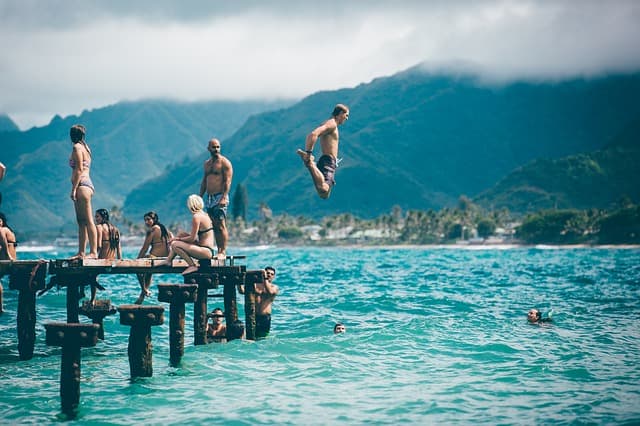
In this picture, what do you think will most probably happen next?
Sample Answer
Looking at this dynamic scene, several highly predictable events are bound to happen within the next few moments. The most immediate and striking action involves the young man who is currently captured mid-air. He will undoubtedly plunge into the crystal-clear, turquoise water below in a matter of seconds, creating a massive splash that will startle and delight those nearby.
Upon his entry into the water, the swimmer floating close to the pier will likely swim further away to avoid being splashed or accidentally collided with. This loud, dramatic splash will trigger immediate laughter and cheers from the group of friends remaining on the wooden dock. The young woman sitting on the edge with her legs dangling will probably pull her feet up slightly to avoid the rising spray, while the bald man standing nearby in swim trunks will watch closely, perhaps shouting words of encouragement or playfully grading his friend's diving form.
Once the diver resurfaces and clears the water from his eyes, he will likely wave to his friends, signaling that the water is warm and inviting. This will encourage the other onlookers to follow suit. The woman standing on the left side of the pier, who seems to be preparing herself, will probably be the next to leap off the edge. Following her, the rest of the group will take turns jumping, creating a continuous cycle of splashing and climbing back up the rustic wooden pillars.
As the afternoon progresses, the low-hanging clouds enveloping the majestic green mountains in the background may roll closer, bringing a light tropical drizzle. This subtle change in weather will eventually prompt the group to gather their belongings, dry off with their towels, and head back toward the town visible in the distance, concluding a memorable and active day at the beach.
Expert Tips & Coaching
Understanding Task 4 (Predicting Situations)
In CELPIP Speaking Task 4, the examiners evaluate your ability to make logical, well-structured predictions based on visual evidence. Unlike Task 3, which requires a literal description of what is happening now, Task 4 demands that you project into the future. You are expected to demonstrate strong grammatical control over future tenses, conditional structures, and modal verbs of speculation, while maintaining a smooth delivery that aligns with CLB 9+ fluency standards.
Maximizing Your 60 Seconds
With only 30 seconds of preparation and 60 seconds of speaking time, efficiency is paramount. Use your preparation time to identify three distinct timelines: the immediate next second (the direct consequence of ongoing actions), the next few minutes (subsequent group interactions), and the next hour (broader environmental or situational changes). By dividing your speaking time into these chronological phases, you ensure a highly organized response that avoids repetitive ideas or awkward silences.
Mastering Future and Conditional Tenses
To achieve a high-scoring CELPIP response, you must move beyond the basic 'will + verb' structure. Incorporate a diverse range of speculative grammar:
- Definite Future: 'He is going to splash...' or 'She will undoubtedly leap...'
- Probable Future (Modals): 'They might decide to...' or 'It is highly likely that...'
- Conditionals: 'If the weather takes a turn for the worse, they will probably pack up their belongings...'
Weak example: 'The man will hit the water. The girl will jump next.'
Better example: 'As soon as the man hits the water, the woman standing on the left is highly likely to follow his lead and plunge in next.'
Avoiding the 'List' Trap: Action + Prediction
Do not simply list what people will do one by one. Instead, create a cause-and-effect narrative. Connect your predictions logically so that one action triggers the next. For instance, the man jumping into the water (Action) will cause a massive splash, which will then cause the sitting onlookers to pull their legs back (Prediction), which will ultimately lead to shared laughter (Subsequent Prediction).
Transitions for Structuring Predictions
Use temporal and cohesive transitions to guide the examiner through your timeline:
- Immediately following this...
- In the moments that follow...
- Shortly thereafter...
- In all likelihood...
- Looking at the broader picture...
Vocabulary Expansion for Speculation and Probability
To elevate your lexical resource score, integrate these sophisticated terms:
- Verbs of Speculation: Anticipate, assume, predict, deduce, forecast.
- Adverbs of Probability: Inevitably, presumably, arguably, potentially, concurrently.
- Descriptive Phrases: A chain reaction, in close succession, a sudden shift in weather, seeking shelter.
Fluency, Pacing, and Handling Unknown Elements
If you encounter an object or action in the picture for which you do not know the exact vocabulary, use circumlocution. For example, if you cannot remember the word 'pier' or 'dock', refer to it as 'the wooden platform extending over the water'. Keep your pacing steady and natural; avoid rushing through your points, as a composed delivery with varied intonation sounds much more native-like.
Common Task 4 Mistakes to Avoid
- Describing instead of predicting: Do not spend time describing what is currently happening. Only mention current actions briefly as a launchpad for your predictions.
- Monotonous grammar: Avoid repeating 'will' in every sentence. Mix in 'is likely to', 'is bound to', and conditional 'if' clauses.
- Unrealistic scenarios: Ensure your predictions are logically derived from the visual evidence in the photo rather than creating highly improbable sci-fi storylines.
Ready to Practice This Topic?
Use our AI-powered tool to record your answer and get instant CLB-scored feedback.
Practice with AI