
Comical Laundromat Mishap
The Question
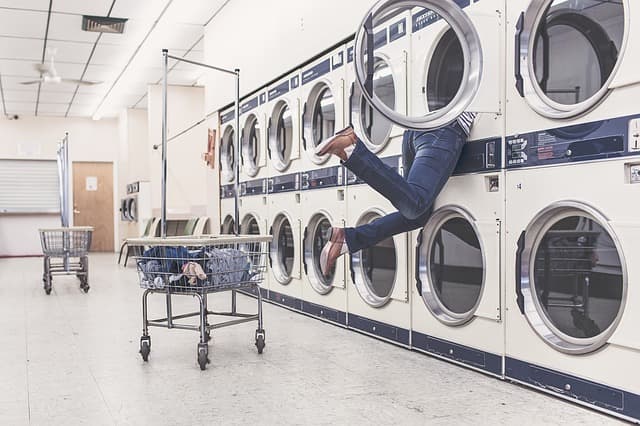
In this picture, what do you think will most probably happen next?
Sample Answer
Based on this comical and highly unusual scene, several events are likely to unfold in the next few moments. First and foremost, the individual who has climbed headfirst into the upper washing machine is going to realize that they are firmly stuck. They will likely begin to frantically kick and flail their legs in an attempt to find leverage against the slippery metal face of the dryer unit. Since their center of gravity is entirely inside the drum, they will find it extremely difficult to pull themselves backward without external assistance.
Within a minute or two, the noise of their kicking and muffled shouts for help will attract the attention of another patron or the laundromat supervisor, who is probably working in the back office. This bystander will walk around the corner, halt in utter disbelief, and immediately rush over to help. After a brief and highly embarrassing exchange, the rescuer will grab the person by their waist or ankles and carefully pull them out of the circular opening.
Once freed, the individual, looking disheveled and incredibly flushed, will offer a sheepish explanation. They will probably reveal that they were trying to retrieve an expensive item of clothing, like a favorite sock or a delicate piece of jewelry, that had slid to the very back of the deep drum. They will thank the helpful bystander profusely while attempting to brush off their dusty jeans and regain some dignity.
In the end, this bizarre incident will wrap up with a sigh of relief. The embarrassed customer will quickly throw their damp clothes into the laundry cart shown in the foreground, pack up their detergent, and exit the premises as fast as possible to escape further awkward stares.
Expert Tips & Coaching
Understanding Task 4 (Making Predictions)
CELPIP Speaking Task 4 asks you to look at an image and predict what is likely to happen next. This task is entirely forward-looking. Unlike Task 3, which requires a literal description of what you see, Task 4 evaluates your ability to speculate, sequence future events, and construct a logical narrative using predictive language.
Examiners look for strategic use of modal verbs, future tenses, and logical transitions that establish cause-and-effect relationships. Your predictions must remain grounded in the visual clues provided, meaning they should be believable and direct extensions of the present moment captured in the image.
Maximizing Your 60 Seconds
With only 30 seconds to prepare and 60 seconds to speak, structural efficiency is key. Do not waste precious seconds describing the scene; jump straight into predictions.
To ensure a rich, continuous flow of ideas, divide your 60 seconds into three distinct logical phases:
- 0-20 seconds: Predict the immediate reaction and physical struggle of the primary character.
- 20-40 seconds: Predict the arrival of an external force or secondary character (e.g., a helper, an authority figure, or an unexpected obstacle).
- 40-60 seconds: Describe the ultimate resolution, the emotional reaction, and the final outcome of the scene. This chronological approach prevents you from running out of things to say.
Mastering Futurity and Probability Expressions
To score CLB 9 or higher, you must demonstrate lexical and grammatical flexibility. Avoid repeating 'will' or 'is going to' constantly. Instead, weave in various levels of probability using advanced structures:
Expressions of High Probability
- *'It is highly anticipated that...' *
- *'There is a strong likelihood that...' *
- *'He is bound to encounter...' *
- *'The situation is likely to escalate when...' *
Expressions of Moderate Probability / Possibility
- *'She might possibly attempt to...' *
- *'It is conceivable that...' *
- *'We can speculate that...' *
- *'They could potentially reach out to...' *
Weak vs. Better Examples
- Weak: 'The man will get out and he will take his clothes and go home.'
- Better: 'It is highly likely that once the man is successfully extricated from the machine, he will quickly gather his belongings to avoid further embarrassment.'
Avoiding the 'Simple Listing' Trap: Cause and Effect
A common pitfall is listing disjointed predictions that lack continuity (e.g., 'A person will come. The clothes will dry. The lights will turn off.'). To achieve advanced fluency, link your predictions together using cause-and-effect language. Every predicted action should naturally trigger the next.
- Step 1 (The Trigger): 'Because the person is stuck headfirst...'
- Step 2 (The Action): '...they will inevitably cry out for help.'
- Step 3 (The Consequence): 'Consequently, this noise will attract the attention of the laundromat manager.'
By establishing this chain, your speech flows naturally and exhibits the high-level critical thinking that CELPIP examiners reward.
Transitions for Sequencing Future Events
Keep your narrative organized using transition words that signal time progression:
- *'In the immediate aftermath...' *
- *'Shortly thereafter...' *
- *'As a direct consequence of this...' *
- *'Following this initial struggle...' *
- *'Ultimately, this will lead to...' *
Vocabulary Expansion for Speculative Situations
Using precise, descriptive vocabulary elevates your language profile. Here are key terms to use when describing this specific laundromat incident or similar mishaps:
- Extricate (verb): To free someone or something from a constraint or difficulty. 'The bystander will try to extricate him.'
- Flail (verb): To wave or swing wildly. 'His legs will continue to flail in the air.'
- Predicament (noun): A difficult, unpleasant, or embarrassing situation. 'He will realize the gravity of his predicament.'
- Sheepish (adjective): Showing embarrassment from shame or a lack of self-confidence. 'He will offer a sheepish smile.'
- Bystander (noun): A person who is present at an event but does not take part. 'An amused bystander will record this on their phone.'
Fluency, Pacing, and Handling Unexpected Scenarios
In Task 4, you might encounter highly unusual or abstract images. If you do, do not panic or overthink. Treat the absurd situation naturally. Maintain your pace by speaking in long, measured breath groups. If you make a grammatical error, do not stop or repeat yourself excessively; simply self-correct smoothly or continue. Use natural fillers like 'that is to say' or 'more precisely' to buy thinking time without dropping your fluency score.
Common Task 4 Mistakes to Avoid
1. Describing Instead of Predicting
- Weak: 'In the picture, a man has his legs sticking out of a washing machine.' (This is a Task 3 description, which gets zero marks in Task 4).
- Improved: 'Looking at the legs sticking out of the washing machine, it is highly probable that this individual will begin to struggle to pull himself backward.'
2. Over-speculating on Unrelated Backstory
Keep your predictions focused on what is physically happening in the scene. Do not spend 45 seconds explaining how the man got there or his childhood history; focus strictly on what will happen next in that specific room.
3. Ignoring the Tone
If the picture is lighthearted or humorous, your predictions can reflect that. Avoid predicting dark, tragic endings (like 'the machine will turn on and he will drown') unless it is clearly a dangerous, dramatic depiction. Keep the tone logical and appropriate.
Ready to Practice This Topic?
Use our AI-powered tool to record your answer and get instant CLB-scored feedback.
Practice with AI