
Beach Handstand and Surfer Prediction
The Question
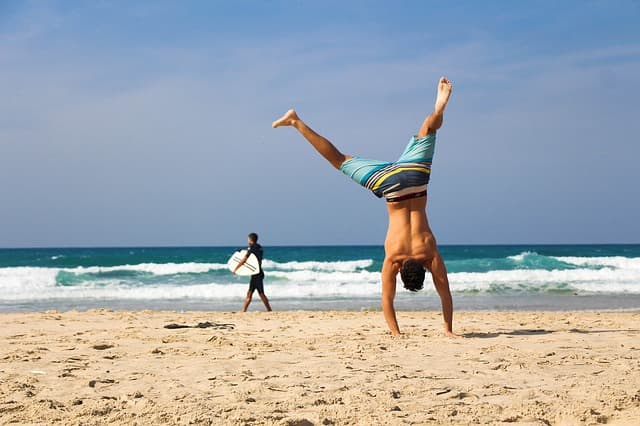
In this picture, what do you think will most probably happen next?
Sample Answer
Based on the vibrant scene captured on this sunny beach, several likely events are poised to unfold in the next few moments. Firstly, looking at the foreground, the young man currently performing a handstand will probably lose his balance. While he seems to have strong control, maintaining such an inverted pose on loose, shifting sand is incredibly challenging. In a few seconds, his arms will likely tire out, causing him to gently tumble forward onto the soft sand. He will probably roll out of the fall safely, sit up, brush the sand off his chest and board shorts, and laugh at his playful attempt before retrieving his belongings. Alternatively, if he is highly skilled, he might transition into a cartwheel or a handstand walk along the shoreline to show off his acrobatic abilities.
Meanwhile, looking at the midground, the surfer carrying the white surfboard will continue making his way towards the ocean. He is currently walking purposefully across the wet sand, and in the next minute, he will reach the edge of the water. He will likely wade in past the shallow, foaming breakers until the water is waist-deep. At that point, he will lie down on his surfboard and begin paddling out towards the larger, breaking waves in the background. Once he gets past the surf line, he will sit on his board, scanning the horizon for the perfect wave to catch, eventually catching a wave and riding it back towards the shore. Overhead, the clear blue sky suggests the pleasant weather will persist, drawing more beachgoers to the shoreline as the afternoon progresses.
Expert Tips & Coaching
Understanding Task 4 (Making Predictions)
In CELPIP Speaking Task 4, you are asked to look at an image and predict what is likely to happen next. Unlike Task 3, which focuses on describing what is currently visible, Task 4 tests your ability to project logical future outcomes based on visual evidence. Examiners are looking for your ability to organize your ideas cohesively, use appropriate future tenses, and employ speculative language. A high-scoring response does not simply guess randomly; it links visible clues in the image to highly probable future occurrences.
Maximizing Your 60 Seconds
You have 30 seconds to prepare and 60 seconds to speak. During the preparation phase, do not try to write down full sentences. Instead, divide the image into two primary areas of action and brainstorm one logical progression for each. For this image, your two focal points are the man doing the handstand and the surfer walking toward the water. Use your preparation time to select future-oriented vocabulary and transition words so you can maintain a steady flow once the recording begins.
Mastering Predictive Grammar and Modal Verbs
To achieve a CLB 9+ score, you must demonstrate a wide range of grammatical structures. Avoid overusing the word 'will'. Instead, incorporate modal verbs of probability and conditional structures.
- Weak: The man will fall down. The surfer will go into the water.
- Better: It is highly probable that the man performing the handstand will eventually lose his balance and tumble onto the soft sand. Simultaneously, the surfer is likely to paddle out past the breakers once he reaches deeper water.
Utilize structures such as 'is/are poised to', 'is likely to', 'might possibly', and 'is expected to' to add sophistication to your speech.
Building Logical Scenarios (Cause and Effect)
Every prediction should be grounded in the visual evidence provided. If you predict that a shark will attack the surfer, that is too dramatic and unrealistic. Instead, focus on the natural progression of the current actions: the gymnast's physical limits and the surfer's preparation. State the cause (the physical difficulty of balancing on sand, walking towards waves) and then describe the logical effect.
Transitional Phrases for Future Outlooks
Smoothly guide your listener from one prediction to the next using robust transitional phrases:
- 'In the immediate future...'
- 'Looking closely at the background, we can anticipate...'
- 'In all likelihood...'
- 'Following this, it is expected that...'
Vocabulary Expansion for Action and Speculation
Enhance your lexical score with specific terminology:
- Acrobatic / Athletic: balancing, tumbling, cartwheel, equilibrium, core strength.
- Marine / Surf: wading, paddling, breakers, shoreline, catching a wave, wetsuit.
- Speculative Adverbs: presumably, inevitably, foreseeably, potentially.
Maintaining Fluency and Pacing
Do not rush your speech. Speak at a moderate, steady pace. If you make a grammatical error, quickly correct yourself and move on without pausing excessively. If you run out of things to say before the 60 seconds are up, elaborate on the long-term weather or potential interactions between the people on the beach.
Common Task 4 Mistakes to Avoid
- Mistake 1: Describing instead of predicting. Do not say 'The man is doing a handstand.' Say 'The man who is currently doing a handstand will likely...'
- Mistake 2: Repetitive sentence structures. Vary your grammar with active future tenses and speculative clauses.
- Mistake 3: Unrealistic predictions. Keep your scenarios grounded in the peaceful beach setting shown in the image.
Ready to Practice This Topic?
Use our AI-powered tool to record your answer and get instant CLB-scored feedback.
Practice with AI