
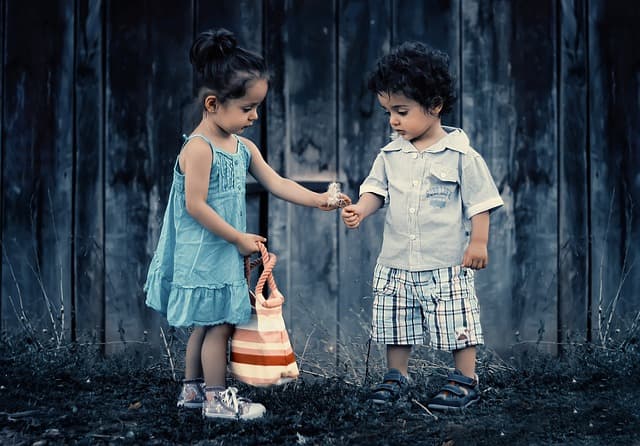
Young Siblings Sharing a Flower by a Wooden Barn
The Question
Describe some things that are happening in the picture below as well as you can. The person with whom you are speaking cannot see the picture.
Sample Answer
This charming and nostalgic photograph captures a tender outdoor scene featuring two young children, possibly siblings, interacting in front of a rustic backdrop. The atmosphere is quiet and intimate, characterized by cool, desaturated tones that make the blue elements of their clothing stand out. The primary activity is the simple, gentle exchange of a wild dandelion between the two toddlers.
In the foreground on the left, a young girl with dark hair tied in a high bun stands in profile, looking toward her companion. She is wearing a light-blue, sleeveless summer dress with ruffled details and is carrying a striped fabric tote bag with orange, peach, and white bands. Her right hand is extended forward, delicately offering a fluffy white dandelion seed head. Immediately opposite her on the right stands a slightly younger boy with short, curly dark hair. He is dressed in a short-sleeved, light-blue button-up shirt and plaid shorts in shades of blue and white, paired with dark blue sandals. He is looking down intently at the flower, his small hand reaching out to receive it from the girl.
Positioned directly behind the two children is a large, weathered wooden structure, likely the wall or door of an old barn or shed. The vertical wooden planks are highly textured, showing deep grooves and a dark, faded blue-grey finish that frames the children perfectly. At their feet, the ground is covered in a dark, dense patch of low-lying wild grass and weeds, which blends smoothly into the dark shadows of the rustic background, enhancing the focus on the bright and gentle interaction in the center.
Overall, the picture evokes a strong sense of innocence, childhood simplicity, and quiet companionship. The soft, diffuse lighting and the cool color palette underscore a calm, serene moment in a rustic, natural environment, emphasizing the heartwarming connection between the two young children.
Expert Tips & Coaching
Understanding Task 3 (Describing a Scene)
CELPIP Speaking Task 3 requires you to verbally paint a picture for someone who cannot see it. The key to achieving a CELPIP Level 9+ is to demonstrate strong spatial organization and exceptional descriptive detail. The examiner evaluates your ability to establish the setting, describe people, actions, and objects accurately, and maintain a highly organized spatial flow. This is not about randomly jumping around the image; it is about systematically guiding your listener's eye from one quadrant to another.
Maximizing Your 60 Seconds
With only 60 seconds of speaking time, planning is crucial. During your 30 seconds of preparation, do not try to write down sentences. Instead, divide the picture into three zones: the general setting, the foreground (the main focus), and the background.
- Spend the first 5-8 seconds establishing the general overview.
- Spend 35-40 seconds on deep, detailed foreground description using the Action + Detail method.
- Use the remaining 10-15 seconds for background elements and the overall mood.
Use our extended sample answers as a repository for high-yield phrases. Memorize spatial connectors so that you do not waste precious cognitive energy during the exam trying to decide how to transition.
Mastering Spatial Prepositions
To help the examiner build an accurate mental map, you must avoid vague terms like 'here' or 'there'. Instead, use highly specific spatial prepositions. Here are key structures to adopt:
- Weak: 'There is a girl on this side, and a boy on that side.'
- Better: 'On the left-hand side of the frame, we see a young girl standing in profile, while directly opposite her on the right-hand side, a young boy is reaching out.'
- Weak: 'Behind them is some wood.'
- Better: 'Directly in the background, serving as a backdrop to the interaction, is a weathered wooden barn door with vertical planks.'
Other high-scoring spatial phrases include:
- 'In the immediate foreground...'
- 'Slightly adjacent to...'
- 'In the upper right-hand corner...'
- 'Juxtaposed against...'
- 'Parallel to...'
Avoiding the 'List' Trap: Action + Detail
A common pitfall that prevents test-takers from scoring CLB 9 or higher is simply listing what they see (e.g., 'I see a girl, a boy, a flower, and a bag'). To score higher, use a three-step descriptive chain: Identify the subject -> Describe their appearance/clothing -> Detail their ongoing action.
- Superficial Point: 'A girl is holding a bag and a flower.'
- High-Scoring CELPIP Point: 'The young girl, who has her dark hair tied up in a neat high bun and is wearing a ruffled blue sleeveless dress, is gently extending her arm to offer a white dandelion seed head to the boy.'
By weaving together descriptors of clothing, physical posture, and continuous actions (using present continuous verbs), you demonstrate grammatical complexity and rich vocabulary.
Transitions for Moving Through a Scene
Smooth transitions keep your description coherent. Use these phrases to shift the focus naturally:
- 'Shifting our focus to the center of the image...'
- 'Immediately adjacent to the young girl, we find...'
- 'If we look closer at the background...'
- 'In contrast to the bright blue of their outfits, the background consists of...'
- 'Turning our attention to the lower portion of the photo...'
Vocabulary Expansion for Visual Imagery
To achieve higher band equivalents on the CELPIP exam, replace basic vocabulary with more sophisticated synonyms:
- Instead of 'old wood', use 'weathered, rustic, or distressed wooden planks'.
- Instead of 'holding a bag', use 'clutching a striped fabric canvas tote'.
- Instead of 'offering a flower', use 'delicately presenting a fluffy white dandelion seed head'.
- Instead of 'green grass', use 'overcast, dark low-lying wild grass and weeds'.
- Instead of 'cute photo', use 'tender, nostalgic, and heartwarming interaction'.
Example Sentence: 'The desaturated color palette of the image creates a stark contrast against the vibrant light-blue of the children's outfits, drawing the viewer's eye immediately to their gentle interaction.'
Fluency, Pacing, and Handling Unknown Words
When describing an image, you might encounter objects whose exact English names you do not know. Do not pause, stutter, or say 'I do not know the word'. Instead, use circumlocution—describe the object's appearance, function, or material.
- Example: If you do not know the word 'dandelion', you can say: '...a small, fluffy white wild flower that looks like a puffball of seeds.'
- Example: If you forget the word 'tote bag', say: '...a small fabric carrying pouch with horizontal colored stripes.'
Maintain a steady, rhythmic pace. A minor pause with a natural filler like 'well' or 'let me see' is acceptable, but avoid frequent 'um' and 'uh' sounds.
Common Task 3 Mistakes to Avoid
- Using Past Tense: Do not say, 'The girl gave him a flower.' Always describe the scene in the present continuous tense as if it is happening right now: 'The girl is offering him a flower.'
- Speculating Too Much on Backstory: Do not waste time saying, 'I think they went to the farm with their parents earlier today and they had lunch.' Stick strictly to what is visually observable. A tiny sentence of speculation at the end is fine, but the core must remain descriptive.
- Getting Stuck in One Corner: Do not spend all 60 seconds describing only the girl's dress. Spend no more than 15-20 seconds per major element to ensure you cover the entire scene.
Ready to Practice This Topic?
Use our AI-powered tool to record your answer and get instant CLB-scored feedback.
Practice with AI