
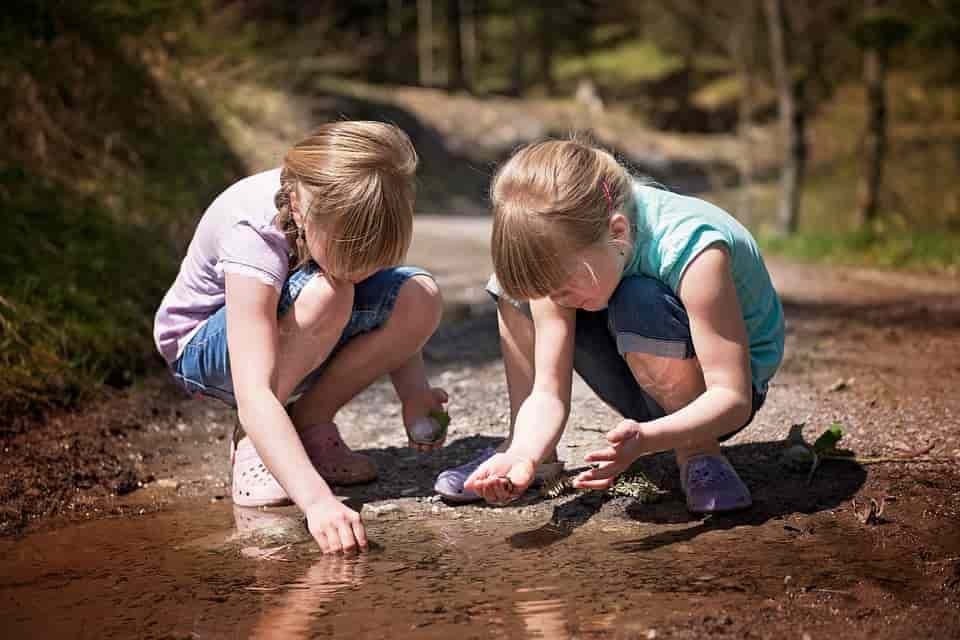
Two Young Girls Exploring a Muddy Puddle in the Woods
The Question
Describe some things that are happening in the picture below as well as you can. The person with whom you are speaking cannot see the picture.
Sample Answer
This is an outdoor scene depicting two young girls engaged in a playful activity on a dirt path, likely situated within a forest or a nature park. The atmosphere is warm and peaceful, with sunlight filtering through the dense foliage in the background, suggesting a bright and pleasant spring or summer afternoon.
In the immediate foreground, two young girls are crouched down side-by-side, intently examining a shallow muddy puddle on the path. On the left, a girl with blonde hair tied in a braid is wearing a pastel purple t-shirt, denim shorts, and pale pink clogs. She is squatting low, leaning forward to gently dip her left hand into the murky water, while holding a small stone or leaf in her right hand. To her right, her companion, also with blonde hair and bangs, is dressed in a turquoise t-shirt, dark jeans, and purple slip-on shoes. She is cupping her hands together, carefully inspecting something she has retrieved from the mud.
The midground consists of the rugged, dry dirt trail which stretches behind the girls, scattered with small pebbles and dry leaves. In the background, the scene transitions into a dense, green woodland with tall trees and lush vegetation. The soft-focus effect in the background emphasizes the peaceful, natural setting, drawing all attention to the girls' quiet exploration. Splashes of sunlight illuminate the ground, creating high-contrast patches of light and shadow along the path, which highlights the muddy textures surrounding the puddle.
Overall, the picture captures a candid and nostalgic moment of childhood curiosity and exploration in nature. The serene lighting and the children's focused expressions convey a sense of wonder and quiet joy as they interact with their natural surroundings.
Expert Tips & Coaching
Understanding Task 3 (Describing a Scene)
In CELPIP Speaking Task 3, you are required to describe a complex visual scene to a listener who cannot see the picture. The primary objective is to test your descriptive ability, vocabulary range, and spatial organization. The examiners evaluate how effectively you paint a mental picture using precise prepositions, vivid adjectives, and natural pacing. Instead of giving a random list of objects, a successful speaker structures their response dynamically, moving from a general overview to specific foreground actions, and then to background details. This creates a logical flow that is easy for the grader to follow.
Maximizing Your 60 Seconds
You only have 60 seconds to speak, which can go by incredibly fast. To maximize this time, you must divide your description systematically rather than getting bogged down in one corner of the image. Spend the first 5 to 7 seconds giving a global summary of the setting. Then, dedicate the next 35 to 40 seconds to the core subjects—usually the people and their active behaviors in the foreground and midground. Finally, spend the last 10 to 15 seconds describing the background elements and the overall atmosphere. If you run out of time before describing everything, do not worry; examiners care much more about the depth, clarity, and grammatical precision of what you do say rather than whether you checked off every single item in the picture.
Mastering Spatial Prepositions
To construct an accurate mental map for the listener, you must master prepositions of place. Avoid vague phrases like 'next to' or 'there is.' Instead, use precise location markers that guide the eye. Here are some key spatial transitions to practice:
- In the immediate foreground... (used for the closest elements, such as the puddle and the girls' hands).
- On the left-hand side of the image... (describing the girl in the purple shirt).
- Directly adjacent to her... or To her immediate right... (transitioning to the girl in the turquoise shirt).
- In the background, slightly out of focus... (describing the dense trees and forest trail).
Let's compare a basic sentence with a high-scoring alternative:
- Weak: 'There is a girl on the left and another girl on the right.'
- Better: 'On the left-hand side of the frame, a young girl is crouching low, while immediately adjacent to her on the right, her companion is mirrored in a similar squatting position.'
Avoiding the 'List' Trap: Action + Detail
A common mistake candidates make is listing objects: 'I see two girls, some water, a dirt path, and some trees.' This simplistic approach limits your vocabulary score and fails to demonstrate conversational fluency. Instead, use the Action + Detail formula. Every time you mention a person or object, immediately connect it to an ongoing action (using the present continuous tense) and a sensory detail (color, texture, or shape).
- Step 1 (Identify): A young girl.
- Step 2 (Add Detail): A young blonde girl wearing a vibrant turquoise t-shirt and dark denim trousers.
- Step 3 (Add Action): A young blonde girl wearing a vibrant turquoise t-shirt and dark denim trousers is crouching on her heels, carefully cupping her hands to examine a small object she has found.
By following this chain, your descriptions become naturally rich and sophisticated, demonstrating your control over complex grammatical structures.
Transitions for Moving Through a Scene
To prevent your response from sounding disjointed, use seamless transitions that shift the focus smoothly across the scene. These transitions act as verbal signposts for the examiner:
- 'Shifting our focus to the center of the image...'
- 'If we look closely at their actions...'
- 'Directly behind the two children...'
- 'In contrast to the bright colors of their clothing, the surrounding path is...'
- 'As we move our eyes toward the background...'
These phrases ensure your speaking flows logically, preventing awkward pauses and helping you maintain a consistent tempo.
Vocabulary Expansion for Visual Imagery
To secure a CLB 9 or higher, you must demonstrate a range of descriptive vocabulary. Avoid generic words like 'good,' 'nice,' 'kids,' or 'forest.' Instead, build a bank of high-yield terms tailored for outdoor and natural settings:
- Verbs of Action & Focus: Squatting, crouching, peering, inspecting, examining, leaning, reaching, dipping, cupping, filtering.
- Nouns & Settings: Muddy puddle, dirt trail, woodland foliage, dense vegetation, natural environment, canopy, shadows, reflections.
- Adjectives for Description: Murky water, pastel purple, vibrant turquoise, soft-focus background, tranquil atmosphere, candid moment, inquisitive expressions.
- Collocations: 'Sunlight filtering through the canopy,' 'intently focused on,' 'interactivity with nature,' 'earthy color palette.'
Example Sentence: 'The sunlight filters through the dense woodland foliage in the background, casting soft shadows across the earthy dirt path.'
Fluency, Pacing, and Handling Unknown Words
Fluency does not mean speaking as fast as you can. It means maintaining a smooth, continuous flow of speech with minimal hesitation. If you stumble upon an object for which you do not know the exact English word, do not panic or stop speaking. Instead, use circumlocution—the art of describing an object using words you do know.
For example, if you do not know the word 'clogs' or 'Crocs,' do not freeze. Instead, say: 'The girl is wearing lightweight, pink rubber slip-on shoes with small ventilation holes on the front.' This shows the examiner that you possess the linguistic flexibility to overcome vocabulary gaps, which is a key indicator of a high-level speaker.
Common Task 3 Mistakes to Avoid
To ensure you do not lose unnecessary points, keep these critical traps in mind:
- Using the Past Tense: Many test-takers accidentally say, 'The girl dipped her hand in the water.' Always use the present continuous tense ('is dipping,' 'are playing,' 'is crouching') because you are describing an ongoing scene happening in the present moment.
- Over-speculating on Backstory: Do not make up a elaborate story about why they are there, such as: 'These two girls are sisters who got lost after school and are trying to survive in the forest.' Stick strictly to what is visually verifiable. A tiny amount of mood interpretation is acceptable ('they look curious'), but avoid inventing non-visible narratives.
- Getting Stuck on One Detail: Do not spend 45 seconds describing only the texture of the girls' hair or the style of their shoes. Balance your time so you cover the subjects, the actions, the setting, and the background environment.
Ready to Practice This Topic?
Use our AI-powered tool to record your answer and get instant CLB-scored feedback.
Practice with AI