
Two Girls Fishing by a Calm Forest Pond
The Question
Describe some things that are happening in the picture below as well as you can. The person with whom you are speaking cannot see the picture.
Sample Answer
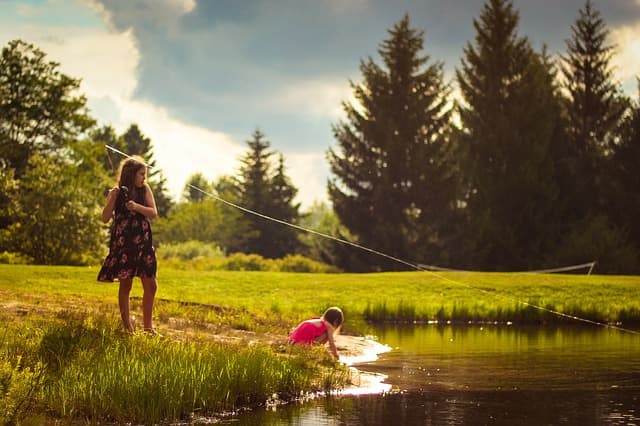
This picturesque image captures a tranquil summer afternoon by a serene pond, where two young girls are enjoying a peaceful day in the heart of nature. The overall atmosphere is incredibly warm and idyllic, highlighted by the lush greenery and soft, golden sunlight filtering through the clouds.
In the foreground on the grassy bank, we see the two main subjects. On the left side, an older girl dressed in a dark, short-sleeved floral dress stands tall and focused. She is holding a long fishing rod, with its thin line stretching diagonally across the calm water. Directly to her right, right at the water's edge, a much younger girl wearing a vibrant pink top is crouched down on the sandy shore. She appears to be looking intently at the water or perhaps playing in the shallow mud near some tall green reeds that sprout along the bank.
Moving into the midground, the still water of the pond occupies a large portion of the right side, beautifully reflecting the warm afternoon light. Beyond the water, an expansive green lawn stretches out, leading towards the background. There, a dense forest of majestic, tall pine trees stands proudly under a dynamic sky filled with soft white and gray clouds. The trees create a natural wall, isolating this peaceful spot from the outside world and enhancing the sense of quiet isolation.
Overall, the scene feels remarkably calm and nostalgic, evoking memories of simple childhood adventures. The bright, natural illumination and the girls' quiet engagement with the environment create a harmonious and peaceful mood that characterizes a perfect summer day outdoors.
Expert Tips & Coaching
Understanding Task 3 (Describing a Scene)
In CELPIP Speaking Task 3, your primary objective is to 'paint a picture' with your words. The examiner cannot see the image, and your job is to describe it so clearly that they can construct an accurate mental map of the scene. To achieve a CLB 9 or higher, you must demonstrate strong organizational skills, precise spatial vocabulary, and grammatical accuracy.
Examiners grade you based on:
- Coherence and Organization: Do you guide the listener logically through the scene, or do you jump randomly from one detail to another?
- Vocabulary: Do you use precise nouns, vivid adjectives, and descriptive verbs instead of generic words like 'stuff', 'things', or 'nice'?
- Grammatical Range and Accuracy: Do you correctly use the present continuous tense for ongoing actions and master spatial prepositions?
Maximizing Your 60 Seconds
With only 30 seconds of preparation and 60 seconds to speak, preparation must be highly structured. Do not try to read the whole picture at once. Instead, divide your preparation time into three phases:
- First 10 Seconds (The Overview): Identify the overall setting (where) and the main subject or theme (what).
- Next 15 Seconds (Spatial Grouping): Identify two or three distinct zones of the picture to describe systematically (e.g., left foreground, right foreground, background).
- Last 5 Seconds (Mental Anchor): Take a deep breath and prepare your first introductory sentence.
During the 60-second speaking window, do not rush. Speak at a steady, natural pace. The extended sample answer provided contains a rich set of vocabulary and structures designed to show you what a maximum-effort answer looks like, but in your actual test, aim to describe 3 to 4 major elements thoroughly rather than listing 10 things superficially.
Mastering Spatial Prepositions
To help the examiner build a mental map, you must anchor every object and person using spatial prepositions. Avoid saying 'there is a girl... and there is another girl... and there are trees.' Instead, use precise location markers.
Essential Spatial Phrases
- In the foreground / in the lower-left corner: Use this to describe elements closest to the viewer.
- Adjacent to / right next to: Perfect for describing the relationship between the two girls.
- Along the shoreline / at the water's edge: Great for positioning the younger girl and the reeds.
- In the background / in the distance: Use this to transition to the forest and sky.
- Stretching across / extending from: Ideal for describing lines, paths, or in this case, the fishing line.
Weak vs. Better Spatial Anchoring
- Weak: 'There is a girl with a fishing rod on the left and a little girl in pink near the water.'
- Better: 'In the left foreground, an older girl is standing on the grassy bank holding a fishing rod, while immediately to her right, a younger girl in a pink top is crouching right at the water's edge.'
Avoiding the 'List' Trap: Action + Detail
A common mistake that limits candidates to CLB 7 or lower is simply listing what they see: 'I see a girl, a fishing rod, some water, some trees, and a pink shirt.' This lacks descriptive depth.
Instead, use the Action + Detail Formula:
Application of the Formula
- Subject: The older girl.
- Spatial Position: On the grassy bank to the left.
- Action: Is standing and holding a fishing rod.
- Specific Description: Wearing a dark floral-patterned dress, looking focused as her line casts over the water.
Combined Sentence: 'On the grassy bank on the left, an older girl wearing a dark floral dress is standing upright, holding a fishing rod with her line cast far across the calm water.'
Transitions for Moving Through a Scene
To achieve CLB 9+ fluency, your sentences must connect smoothly. Transition words prevent your speech from sounding like a series of disconnected bullet points.
Use these transitional phrases to move the listener's eyes through the image:
- 'Shifting our focus to the center foreground...'
- 'Immediately adjacent to her...'
- 'If we look deeper into the midground, we can see...'
- 'In the far background, dominating the horizon...'
- 'Directly behind the two girls, the landscape opens up into...'
Vocabulary Expansion for Visual Imagery
To boost your vocabulary score, replace basic terms with high-yield synonyms and descriptive collocations.
Setting and Nature
- Instead of 'water' or 'lake': Use 'calm pond', 'tranquil water', 'still shoreline'.
- Instead of 'forest' or 'trees': Use 'dense evergreen forest', 'tall pine trees', 'lush vegetation'.
- Instead of 'grass': Use 'grassy bank', 'verdant lawn', 'tall reeds'.
Human Actions and Appearance
- Instead of 'sitting': Use 'crouching down', 'kneeling at the edge', 'bending over'.
- Instead of 'holding': Use 'gripping the rod', 'firmly grasping'.
- Instead of 'wearing': Use 'clad in a pink top', 'dressed in a floral-patterned dress'.
Sentences in Action
- 'The still surface of the pond perfectly reflects the warm, natural lighting of the late afternoon.'
- 'A dense wall of evergreen pine trees dominates the background, creating a sense of serene isolation.'
Fluency, Pacing, and Handling Unknown Words
When speaking for 60 seconds, maintaining continuous speech is critical. If you hesitate, repeat words, or stop to think, your fluency score will drop.
How to Handle Unknown Words (Circumlocution)
What if you do not know the word for 'fishing rod' or 'reeds'? Do not panic. Use circumlocution (describing the object using words you do know):
- Fishing rod: 'A long, slender pole used for catching fish.'
- Reeds: 'Tall, grass-like plants growing out of the water near the shore.'
- Casts: 'Throwing the line into the water.'
Controlling Your Pace
Keep your breathing steady. It is better to speak slightly slower with clear pronunciation and grammatically correct sentences than to rush, stumble, and leave sentences unfinished. Use natural fillers like 'Let me see...', 'Looking closely at...', or 'Another detail to note is...' to give your brain a millisecond to plan the next clause.
Common Task 3 Mistakes to Avoid
Mistake 1: Using Simple Past Tense
- Incorrect: 'The girl caught a fish and her sister sat down.'
- Why: The scene is frozen in time, but we describe it as an ongoing live action.
- Correct: 'The girl is holding a fishing rod and her sister is crouching near the water.' (Present Continuous)
Mistake 2: Speculating Excessively on a Backstory
- Incorrect: 'These two girls are sisters. They are fishing because their father taught them how to fish last week, and they want to catch dinner for their family.'
- Why: Task 3 requires you to describe what is visible. Speculation belongs in Task 4 (Making Predictions). Keep your focus on physical details.
- Correct: 'The two girls appear to be sisters enjoying a quiet afternoon of fishing together in a natural setting.' (Brief observation is okay, but transition immediately back to physical description).
Mistake 3: Zooming in on Only One Detail
- Incorrect: Spending all 60 seconds describing the pattern on the older girl's dress.
- Correct: Balance your description across the foreground (the girls), midground (the water and shoreline), and background (the forest and sky) to show a complete understanding of the entire scene.
Ready to Practice This Topic?
Use our AI-powered tool to record your answer and get instant CLB-scored feedback.
Practice with AI