
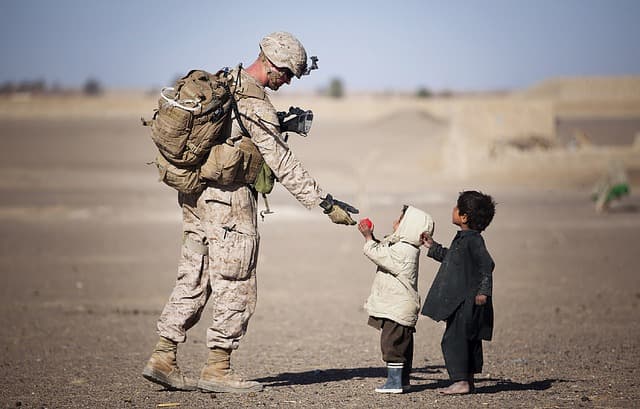
Soldier Handing a Toy to Children in the Desert
The Question
Describe some things that are happening in the picture below as well as you can. The person with whom you are speaking cannot see the picture.
Sample Answer
This compelling image depicts a heartwarming interaction between a soldier and two young children set against a vast, arid desert landscape. The atmosphere appears quiet yet tense, with the central focus highlighting a gentle moment of human connection amidst a barren and dusty environment.
In the foreground on the left-hand side, a soldier stands clad in a full desert camouflage uniform, complete with a helmet, combat boots, and a massive tactical rucksack strapped to his back. He is leaning slightly forward and extending his gloved left hand to offer a small, bright red circular object, which looks like a small fruit or a ball, to the children. Facing him on the right is a small child wearing a thick, cream-colored hooded jacket, dark brown trousers, and blue boots, reaching up with both hands to accept the gift. Immediately adjacent to this child is another youth, barefoot and dressed in simple dark clothing, who stands watching the encounter with curious attention.
In the midground and background, the terrain is dominated by flat, dry, sandy earth that stretches out towards the far horizon under a pale, clear sky. To the far right in the background, there are faint, low-lying mud-brick structures or simple dwellings, suggesting a rural or remote desert settlement. The shadows cast by the figures on the dusty ground suggest that the sun is high in the sky, illuminating the entire open area.
Overall, the scene beautifully contrasts the heavy, structured gear of the military personnel with the simplicity and vulnerability of the local children. This stark juxtaposition underscores a touching moment of warmth and shared humanity in an otherwise harsh and challenging geographical environment.
Expert Tips & Coaching
Understanding Task 3 (Describing a Scene)
In this part of the exam, your ability to paint a clear, coherent mental picture is evaluated on a 12-point scale aligned with Canadian Language Benchmark (CLB) levels. Examiners are not just looking for a simple list of objects; they assess your systematic approach to spatial organization, grammar range, precision of vocabulary, and overall fluency. To secure a CELPIP Level 9+ response, you must structure your description logically so that an individual who cannot see the picture can reconstruct it accurately in their mind. This requires starting with a high-level overview, moving systematically through different areas of the image, and concluding with an atmospheric observation.
Maximizing Your 60 Seconds
The preparation time of 30 seconds is brief, so you must establish a systematic scanning strategy immediately. Avoid trying to describe every single pebble or fold in the clothing. Instead, split the image into three main zones: the foreground focus, the background context, and the overarching mood. During your 60-second speaking time, maintain a steady, controlled pace rather than rushing to cover everything. Use the extended model answer as a guide to learn how to stretch simple descriptions into rich, prepositionally complex sentences that demonstrate high-level fluency.
Mastering Spatial Prepositions
Using precise spatial prepositions is critical for establishing where elements are located in relation to one another. Weak descriptions rely on vague terms like 'here' or 'there', whereas high-scoring responses utilize specific locational markers.
- Weak: 'There is a soldier on the left and kids on the right.'
- Better: 'In the left-hand foreground, a soldier stands in profile, while directly opposite him on the right, two children await.'
- Weak: 'In the back, there are houses.'
- Better: 'In the far right background, the faint outlines of low-lying mud-brick structures are visible against the horizon.'
- Weak: 'The soldier has a bag on his back.'
- Better: 'Mounted on the soldier's back is a bulky, tan-colored tactical rucksack.'
Avoiding the 'List' Trap: Action + Detail
A common pitfall is listing items: 'I see a soldier, a bag, a child, some sand, and a house.' This keeps your score capped at a lower level. Instead, use the 'Action + Detail' formula. Identify the subject, describe what they are wearing or their physical state, and then explain their current action using present continuous verbs.
- Weak example: 'The soldier is giving something to a child.'
- High-scoring example: 'The soldier, who is fully geared in desert camouflage and a tactical helmet, is leaning forward to gently offer a small red object to a child wearing a cream hooded jacket.'
By connecting physical description to active verbs, you demonstrate a wider range of vocabulary and more sophisticated grammatical structures.
Transitions for Moving Through a Scene
Smooth transitions allow the examiner to follow your voice effortlessly across the canvas of the image. Practice using these transitional phrases:
- 'Shifting our focus to the right side of the frame...'
- 'Immediately adjacent to the first child...'
- 'In the background, stretching out behind the main subjects...'
- 'Taking a closer look at the foreground...'
- 'On the periphery of the scene...'
Vocabulary Expansion for Visual Imagery
To achieve strong CLB 9-level fluency, you need to use descriptive collocations and specific nouns.
- 'Desert camouflage': Military clothing designed to blend into arid environments.
- 'Tactical rucksack': A heavy-duty backpack used by soldiers.
- 'Arid terrain': Extremely dry and barren land.
- 'Stark contrast': An obvious and striking difference between two things.
- 'Vulnerability': A state of being exposed or delicate, as seen in the barefoot child.
Example sentences:
- 'The arid terrain highlights the isolated nature of the settlement.'
- 'There is a stark contrast between the heavily armored soldier and the vulnerable, barefoot child.'
Fluency, Pacing, and Handling Unknown Words
If you do not know the exact word for an object (such as 'rucksack' or the specific name of the red item), do not freeze or say 'I don't know.' Use circumlocution—the art of describing an object using words you do know. For example, you can say 'a large, specialized military backpack' or 'a small, circular red item resembling a fruit or a toy.' Keep your voice steady, utilize natural fillers like 'that is to say' or 'more specifically,' and avoid long pauses.
Common Task 3 Mistakes to Avoid
- Using the past tense: Always describe the scene in the present continuous tense (e.g., 'the soldier is offering' rather than 'the soldier offered').
- Over-speculating: Do not invent complex background stories about why the soldier is there or what happened before. Stick to what is physically visible in the image.
- Getting stuck in one corner: Avoid spending the entire 60 seconds describing only the soldier's backpack. Ensure you allocate time to cover the children and the background environment.
- Weak: 'The soldier had a hard day and he decided to give a child an apple.'
- Improved: 'The soldier is currently handing a small red object to the child, which represents a gentle moment of connection.'
Ready to Practice This Topic?
Use our AI-powered tool to record your answer and get instant CLB-scored feedback.
Practice with AI