
Social Gathering with Cocktails at a Modern Bar
The Question
Describe some things that are happening in the picture below as well as you can. The person with whom you are speaking cannot see the picture.
Sample Answer
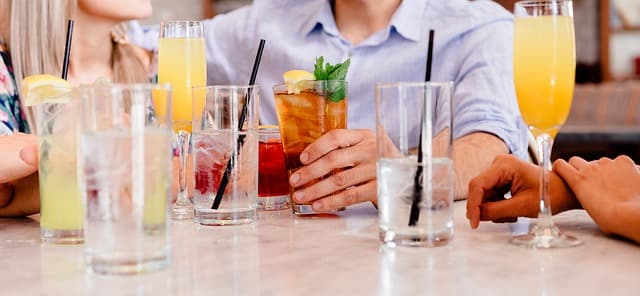
This vibrant close-up photograph captures a lively social gathering at a contemporary bar or restaurant. The main focus is on an array of colorful, refreshing cocktails and drinks arranged on a sleek, light-colored marble countertop, where several people are enjoying a casual get-together.
In the immediate foreground, a variety of glasses are meticulously arranged across the bar. On the left side, there is a tall glass containing a light yellow, citrus-infused beverage decorated with a lemon wedge on the rim, positioned next to a tumbler filled with clear water and ice. Near the center, a man's hand is holding a tall highball glass filled with amber-colored iced tea, garnished beautifully with a fresh mint sprig and a slice of lemon. Adjacent to this, we can see other drinks, including a vibrant red cocktail in a short glass and two elegant champagne flutes filled with bright yellow mimosa cocktails on the far left and right.
Behind the drinks, several individuals are partially visible, suggesting a warm and friendly atmosphere. A man in a light blue button-down shirt has his hand wrapped around the iced tea glass, with his other arm casually resting near a woman with blonde hair wearing a floral dress on the left. On the far right-hand side of the counter, the hands of other guests are visible, resting casually on the marble surface, indicating active conversation and engagement among the group.
The overall mood of the scene is highly energetic and cheerful, characterized by bright, warm lighting and a sense of shared celebration. This image beautifully portrays a typical weekend social gathering, emphasizing friendship, relaxation, and pleasant conversation over refreshing drinks.
Expert Tips & Coaching
Understanding Task 3 (Describing a Scene)
In CELPIP Speaking Task 3, you are required to describe a static picture to a listener who cannot see it. Your primary goal is to paint a vivid mental picture using clear, structured language. To achieve a CLB 9 or higher, you must focus on three core criteria: spatial organization, lexical range, and grammatical accuracy. The examiners are looking for your ability to organize details logically (from the foreground to the background, left to right) rather than listing items randomly. Furthermore, you must showcase your vocabulary by using precise nouns, descriptive adjectives, and strong spatial prepositions.
Maximizing Your 60 Seconds
You are given 30 seconds to prepare and 60 seconds to speak. During the preparation phase, do not try to write out sentences. Instead, divide the picture into three main regions: the foreground (what is closest to you), the midground/center (the main action or subject), and the background (the setting). Use the extended sample answer as a guide to learn high-yield phrases. When speaking, maintain a steady, natural pace. If you rush, you will run out of things to say before the timer ends. If you speak too slowly, you will fail to cover the entirety of the scene. Aim to spend about 15 seconds on the general overview, 35 seconds on specific details using spatial transitions, and 10 seconds on the overall atmosphere.
Mastering Spatial Prepositions
To help the listener visualize the scene, you must position every object accurately. Avoid using vague phrases like 'there is a glass here' or 'I see a man there'. Instead, use highly specific spatial prepositions to guide your examiner's imagination.
Examples of Spatial Prepositions:
- 'In the immediate foreground...'
- 'On the left-hand side of the counter...'
- 'Directly adjacent to the water tumbler...'
- 'Parallel to the champagne flute...'
- 'In the background, partially obscured...'
- 'At the center of the frame...'
Weak vs. Better Examples:
- Weak: 'There is a yellow drink on the left and a water glass next to it.'
- Better: 'In the lower-left corner of the marble counter, a tall glass containing a pale yellow citrus beverage stands immediately adjacent to a short tumbler filled with ice and clear water.'
Avoiding the 'List' Trap: Action + Detail
A common mistake candidates make is simply listing the items they see: 'I see a glass, a hand, a shirt, and a table.' This approach limits your score. To score a Level 9+, you must use the 'Action + Detail' formula. Identify an object or person, describe their appearance or features, and explain what action is occurring using present continuous verbs.
High-Scoring Formula:
- State the Subject: 'A man in a light blue button-up shirt...'
- Add Detail/Appearance: '...who is wearing a light-colored collared shirt...'
- Describe the Action: '...is firmly gripping a tall glass of iced tea garnished with fresh mint and lemon.'
Transitions for Moving Through a Scene
Smooth transitions keep your description organized and prevent your response from sounding like a series of disconnected sentences. Use these transitions to shift the examiner's focus smoothly across the scene:
- 'Shifting our focus to the center of the image...'
- 'Directing our attention slightly to the right...'
- 'Looking just behind the main arrangement of glasses...'
- 'On the periphery of the scene...'
- 'Contrasting with the foreground elements...'
Vocabulary Expansion for Visual Imagery
Using specific, advanced vocabulary shows the examiners that you have a broad lexical resource. Replace basic words with descriptive alternatives:
- Instead of 'drink', use: 'cocktail', 'beverage', 'concoction', 'refreshment', 'mimosa'.
- Instead of 'table', use: 'sleek marble countertop', 'bar surface', 'marble bar'.
- Instead of 'holding', use: 'clutching', 'gripping', 'cradling'.
- Instead of 'happy', use: 'lively', 'convivial', 'festive', 'celebratory'.
Vocabulary Sentences:
- 'The vibrant yellow mimosas are served in elegant champagne flutes, adding a sophisticated touch to the gathering.'
- 'The counter features a polished, light-colored marble texture that reflects the ambient lighting of the venue.'
Fluency, Pacing, and Handling Unknown Words
During the test, you might encounter an object you do not know the exact name of. Do not freeze or say 'I do not know what this is.' Instead, use a technique called circumlocution—describe the object's appearance, function, or material. For example, if you do not know the word 'mimosa', you can say: 'an orange-colored sparkling beverage served in a narrow, tall wine glass.' This shows the examiner that you can communicate flexibly under pressure. Maintain your fluency by using natural conversational fillers like 'actually', 'as you can see', or 'interestingly' to give yourself a moment to think.
Common Task 3 Mistakes to Avoid
- Mistake 1: Using the Past Tense. Never say 'The man held a glass.' Always describe the scene in the present continuous tense: 'The man is holding a glass.'
- Mistake 2: Making Up a Backstory. Do not speculate excessively. Avoid saying: 'These people are celebrating a promotion because they got a raise.' Stick to what is visually verifiable: 'They appear to be celebrating a social occasion, as indicated by the variety of colorful cocktails.'
- Mistake 3: Getting Stuck in One Corner. Do not spend all 60 seconds describing only the yellow drink on the left. Ensure you move across the entire picture so the listener gets a complete, balanced overview.
Ready to Practice This Topic?
Use our AI-powered tool to record your answer and get instant CLB-scored feedback.
Practice with AI