
Exciting Family Water Fight at a Sunny Splash Park
The Question
Describe some things that are happening in the picture below as well as you can. The person with whom you are speaking cannot see the picture.
Sample Answer
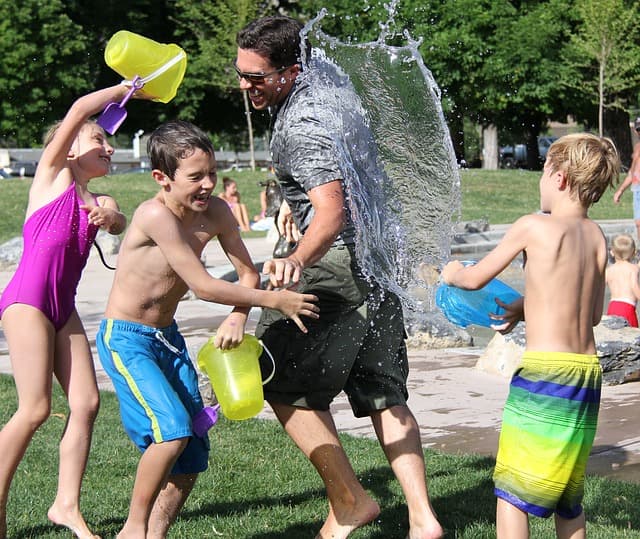
This vibrant photograph captures a joyful, sun-drenched summer scene at an outdoor park or splash pad, where a family is engaged in a lively water fight. The atmosphere is filled with pure excitement and laughter as a father and three young children play together on a wet concrete area surrounded by lush green lawns.
In the center of the image, a barefoot man wearing sunglasses, a grey wet shirt, and dark green cargo shorts is playfully reacting to a massive splash of water hitting his back. On the far left, a young girl in a bright fuchsia one-piece swimsuit stands on the grass, holding a yellow plastic bucket upside down over her head as if she has just emptied it. Directly next to her is a boy wearing blue swim trunks with a yellow side stripe, who is laughing hysterically and lunging forward with an empty yellow bucket and a purple shovel in hand.
On the right side of the frame, another shirtless boy wearing bright green, yellow, and blue striped swim trunks is captured from behind, holding a translucent blue bucket and splashing water directly toward the father. In the background, beyond the immediate splash zone, we can see a wide-open park with green grass and mature trees. To the left, a woman in a pink swimsuit is sitting on the grass, while further back on the right, a smaller child in red shorts is visible near the water fountain.
Overall, the bright, natural sunlight and the crystal-clear water droplets frozen in mid-air emphasize the refreshing and energetic nature of this hot summer day. The scene beautifully showcases a happy family creating wonderful memories together through active outdoor play.
Expert Tips & Coaching
Understanding Task 3 (Describing a Scene)
In CELPIP Speaking Task 3, your primary objective is to paint a vivid mental picture of a complex scene for a listener who cannot see the image. The examiners are assessing your spatial organization, vocabulary diversity, and grammatical control, particularly your use of the present continuous tense to describe ongoing actions. A high-scoring response is not just a random assortment of observations; it is a structured, logical tour of the picture that allows the listener to easily map the characters and actions in their minds.
Maximizing Your 60 Seconds
With only 30 seconds to prepare and 60 seconds to speak, strategic planning is critical. Spend your preparation time identifying the main focus (the 'anchor' of the photo) and at least three distinct supporting details in different areas of the image. When you begin speaking, do not try to describe every single blade of grass or tiny background object. Instead, use our extended sample answer as a study guide to build a repertoire of flexible phrases, then select the most prominent visual elements to discuss during the exam. Pace yourself so you do not run out of time before describing the background.
Mastering Spatial Prepositions
To help the examiner reconstruct the image mentally, you must use precise prepositions of place. Avoid generic terms like 'here' or 'there'. Instead, use structured directional phrases:
- Weak: 'There is a boy on the right side.'
- Better: 'On the right-hand side of the frame, a young boy with striped swim trunks is standing with his back to the camera.'
- Weak: 'A girl is next to a boy.'
- Better: 'Immediately adjacent to the laughing boy on the left, a young girl in a pink swimsuit is holding a yellow bucket.'
Use phrases like 'in the foreground', 'in the upper-right quadrant', 'in the background', and 'parallel to' to establish clear spatial relationships.
Avoiding the 'List' Trap: Action + Detail
A common pitfall is listing objects: 'I see a man, a girl, some water, and grass.' This keeps your score low. Instead, use the 'Action + Detail' formula. For every element you mention, state who they are, what they are wearing or their physical appearance, and their active movement using present continuous verbs.
- Weak: 'A man is getting wet.'
- Better: 'A middle-aged man wearing sunglasses and wet cargo shorts is laughing as a large wave of water splashes across his back.'
This formula naturally incorporates advanced adjectives and complex sentence structures.
Transitions for Moving Through a Scene
Smooth transitions prevent your speech from sounding robotic. Use these transitional phrases to guide your listener's focus:
- 'Shifting our focus to the left side of the scene...'
- 'Directly behind the main group...'
- 'In the background, further in the distance...'
- 'Turning our attention to the foreground...'
Using these markers demonstrates high-level coherence and conversational control.
Vocabulary Expansion for Visual Imagery
To achieve CLB 9 or higher, replace basic words with descriptive synonyms:
- Instead of 'water': 'a cascade of water', 'water droplets', 'a powerful splash'.
- Instead of 'happy': 'exuberant', 'ecstatic', 'filled with glee'.
- Instead of 'park': 'sun-drenched public park', 'recreational splash pad'.
- Example sentence: 'The ecstatic children are playfully splashing their father, creating a dynamic cascade of water that sparkles in the sunlight.'
Fluency, Pacing, and Handling Unknown Words
Maintain a steady, natural pace. If you stumble upon an object whose name you do not know, do not freeze. Use circumlocution (describing the object using words you do know). For example, if you forget the word 'spade' or 'shovel', you can say 'a plastic tool used for digging in sand'. This demonstrates linguistic flexibility and prevents long, awkward pauses.
Common Task 3 Mistakes to Avoid
- Using Simple Past Tense: Always describe a scene in the present continuous tense (e.g., 'they are playing', not 'they played').
- Speculating on Backstory: Do not make up long stories about why they are there; stick to what is visually verifiable.
- Getting Stuck in One Corner: Spend no more than 15-20 seconds on any single detail to ensure you cover the entire scene.
- Weak: 'The family went to the park because it was hot and they had fun.'
- Improved: 'The family is currently enjoying a refreshing water fight on what appears to be a hot summer day.'
Ready to Practice This Topic?
Use our AI-powered tool to record your answer and get instant CLB-scored feedback.
Practice with AI