
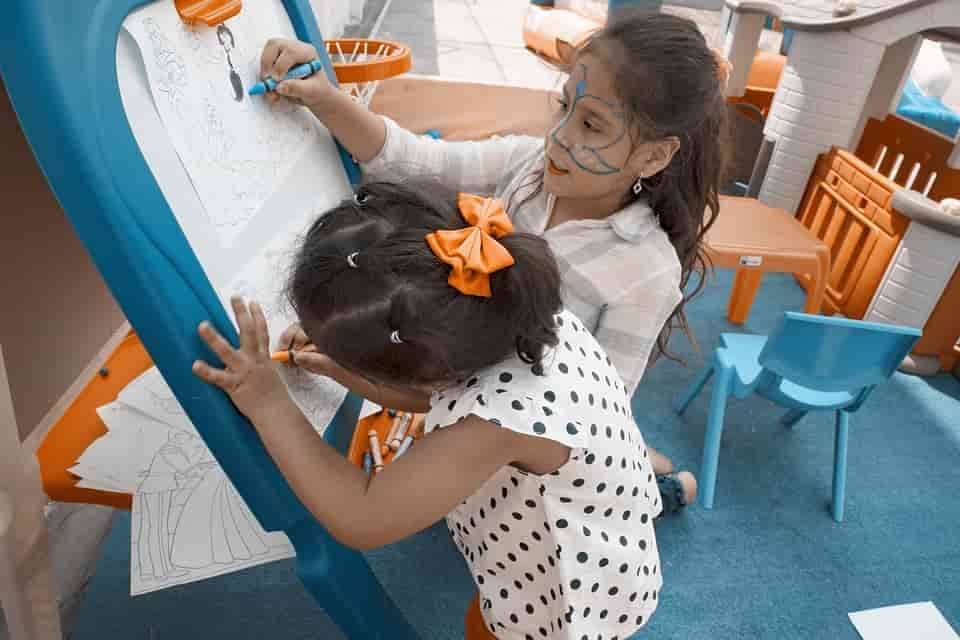
Children Coloring on an Easel in a Playroom
The Question
Describe some things that are happening in the picture below as well as you can. The person with whom you are speaking cannot see the picture.
Sample Answer
This image depicts a vibrant, cheerful playroom or early childhood learning center where two young girls are deeply engaged in an artistic activity. The overall atmosphere is lively, creative, and filled with the warmth of childhood play, suggesting a structured day-care or recreational facility designed for creative learning.\n\nIn the foreground, on the left side of the frame, a young girl with her dark hair styled in two adorable pigtails secured by a large, bright orange bow is leaning intently over a blue double-sided plastic easel. She is wearing a sleeveless white top patterned with bold black polka dots. With her right hand, she carefully guides an orange crayon across a sheet of paper featuring line-art outlines ready to be colored, displaying an intense level of focus and dedication.\n\nImmediately adjacent to her, slightly in the midground and to the right, another young girl is also coloring on the upper section of the easel. This older girl, sporting whimsical blue butterfly face paint around her eyes and wearing a light-colored, long-sleeved plaid shirt, holds a blue crayon as she carefully colors a separate sheet of paper. Her long brown hair is styled half-up, revealing a small earring. The background behind them reveals a well-equipped play area, featuring a miniature orange table, a tiny blue plastic chair, a small plastic basketball hoop, and components of a beige plastic playhouse, all resting on a soft blue carpeted floor.\n\nOverall, the scene captures a beautiful moment of deep concentration and creative exploration. The bright natural lighting, colorful furniture, and playful environment all combine to paint a picture of a highly nurturing space where children are encouraged to express themselves freely through art and imaginative play.
Expert Tips & Coaching
Understanding Task 3 (Describing a Scene)\nIn Task 3 of the CELPIP speaking test, you are required to describe a complex visual scene to a listener who cannot see the picture. The examiners evaluate your ability to provide a structured, spatially organized description using precise language. The key here is not just listing random objects but mapping the scene for the listener using precise prepositions, descriptive vocabulary, and appropriate grammar, primarily the present continuous tense.\n\n## Maximizing Your 60 Seconds\nYou have 30 seconds to prepare and 60 seconds to speak. During your preparation, do not try to write out sentences. Instead, divide the image into zones: foreground, background, left, and right. Pick the most prominent elements first, and then find 2 to 3 secondary details to flesh out. This extended sample answer is designed as a study script; do not feel pressured to speak this rapidly in the exam. Instead, harvest high-yield phrases from it to make your description flow naturally without long pauses.\n\n## Mastering Spatial Prepositions\nUsing directional language helps the examiner build a mental map of the image. Avoid saying 'The girl is next to the other girl'. Instead, use structured phrases:\n- Weak: 'There is a girl on the left and a girl on the right.'\n- Better: 'In the foreground, on the left side of the frame, a young girl is leaning over...'\n- Weak: 'In the back there is a chair.'\n- Better: 'In the background, immediately behind the children, we can see a small blue plastic chair...'\n\n## Avoiding the 'List' Trap: Action + Detail\nNever simply list items like: 'I see a table, a chair, an easel, and face paint.' Instead, use a descriptive chain: Identify the Person/Object -> Describe Appearance -> Detail Ongoing Action.\n- Weak: 'A girl is drawing.'\n- Better: 'A young girl sporting blue butterfly face paint around her eyes is using a blue crayon to color a drawing on the upper portion of the easel.'\n\n## Transitions for Moving Through a Scene\nKeep your transitions smooth so the listener can easily follow your visual journey:\n- 'Moving our focus slightly to the background...'\n- 'Immediately adjacent to the girl in the polka dot shirt...'\n- 'In the top right quadrant of the image, we can observe...'\n- 'If we look closer at the details in the foreground...'\n\n## Vocabulary Expansion for Visual Imagery\nEnhance your lexical score by using specific descriptive words:\n- Nouns: Easel, pigtails, face paint, recreational facility, line-art, polka dots.\n- Adjectives: Engrossed, whimsical, vibrant, double-sided, miniature, nurturing.\n- Verbs: Leaning over, guiding, coloring, sporting, resting.\nExample Sentence: 'The girl is deeply engrossed in her coloring, holding her crayon firmly as she works on the easel.'\n\n## Fluency, Pacing, and Handling Unknown Words\nIf you do not know the exact word for an object (e.g., 'easel' or 'pigtails'), use circumlocution. Instead of stopping, describe it: 'She is drawing on a blue standing drawing board' or 'Her hair is tied in two small bunches on the sides of her head.' Keep your pacing steady and use natural transition fillers like 'Looking closely, we can see' instead of silent pauses or 'uhm'.\n## Common Task 3 Mistakes to Avoid\n- Mistake 1: Using the simple past tense (e.g., 'She colored a paper'). Always use the present continuous (e.g., 'She is coloring a paper') because you are describing an ongoing scene.\n- Mistake 2: Over-speculating (e.g., 'They are sisters and their mom took them to the mall after school'). Only describe what is physically visible in the image.
Ready to Practice This Topic?
Use our AI-powered tool to record your answer and get instant CLB-scored feedback.
Practice with AI